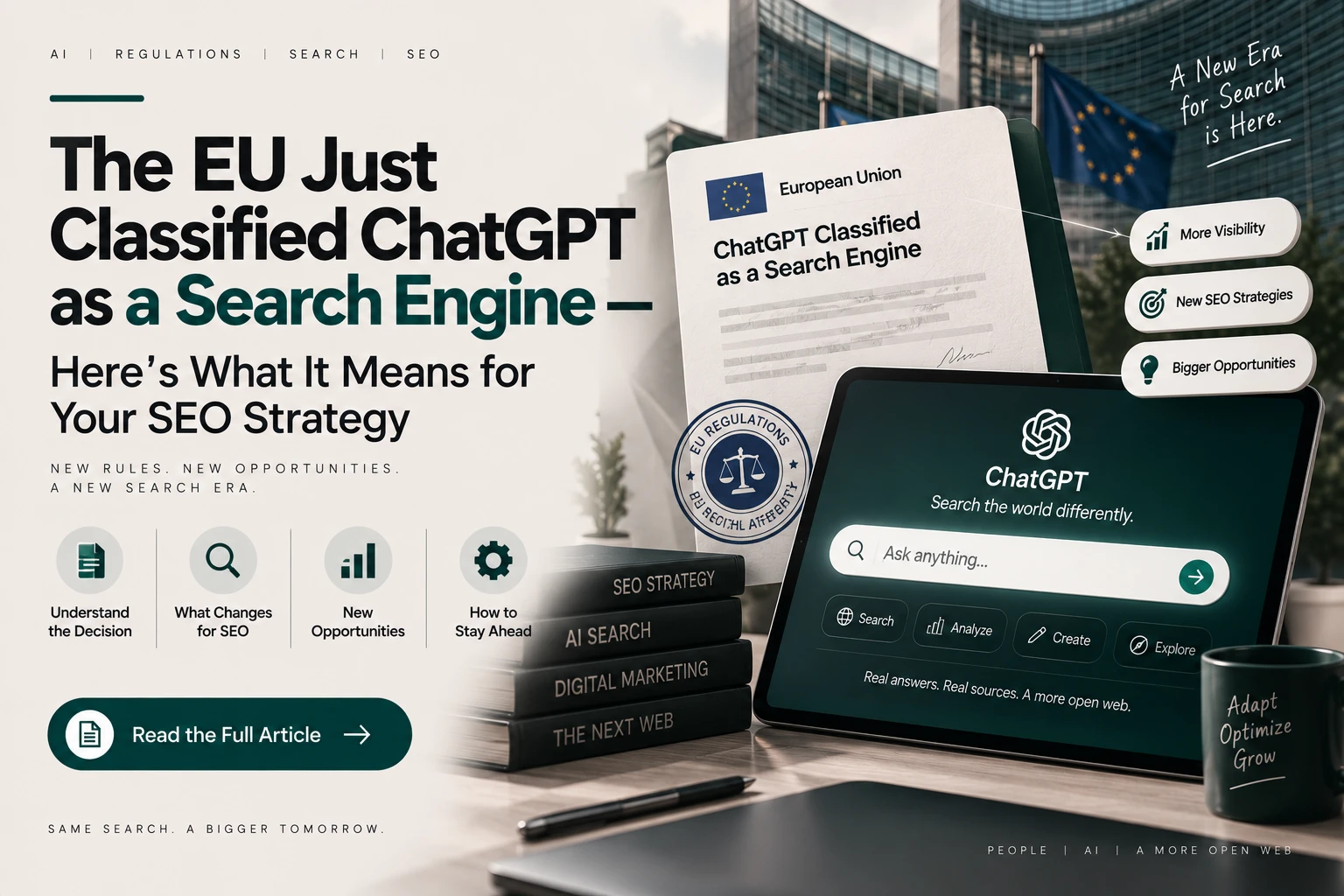
On August 31, 2026, the European Commission did something it had never done before: it formally classified an AI chatbot as a search engine. ChatGPT is now designated a “Very Large Online Search Engine” (VLOSE) under the EU’s Digital Services Act — the same strict regulatory category that governs Google Search. This isn’t just a legal technicality. It’s the clearest official confirmation yet that regulators themselves now view AI chat tools as genuine search infrastructure, not a novelty sitting alongside search. Here’s what that actually means if you run a business website.
What Actually Happened
The European Commission determined that ChatGPT had crossed the DSA’s threshold of 45 million average monthly users in the EU — by a wide margin, reporting closer to 159 million. Because ChatGPT can search the web and return information gathered from online sources in addition to answering conversational prompts, the Commission classified it as a “hybrid service” that qualifies as an online search engine under the DSA, placing it under the same category of obligations that apply to Google Search, alongside major platforms like YouTube and Instagram.
OpenAI now has until the end of 2026 to comply with a substantial set of new obligations: risk assessments, independent audits, algorithmic transparency disclosures, restrictions on targeted advertising to minors, and data access requirements for regulators and vetted researchers. Non-compliance risks fines of up to 6% of global annual revenue — the same maximum penalty structure that applies to Google under the same law.
Why This Matters Beyond the Legal Headline
This designation is significant for a reason that has nothing to do with EU compliance paperwork: it’s an official, government-level confirmation of something SEO professionals have been arguing for the past year — that AI chat tools function as search engines for a meaningful share of users, and businesses need to optimize their visibility within them accordingly.
The Commission’s own reasoning centers on ChatGPT’s “live web-search function” specifically — not the chatbot as a whole — which is a useful distinction. It confirms that the search-and-cite behavior increasingly common across AI tools (ChatGPT, Gemini, Perplexity, Claude) is being treated by regulators as functionally equivalent to traditional search, which strengthens the case that businesses should be optimizing content to be found and cited by these tools, not just ranked by Google.
What This Means for Your Website and Content Strategy
Being cited in AI-generated answers is no longer a “nice to have” side project. If regulators are treating AI search as comparable to traditional search in scale and impact, businesses should treat visibility within it as a comparable priority — not an experimental afterthought bolted onto a traditional SEO strategy.
Expect more transparency into how these systems select and cite sources. Part of the DSA’s requirements includes disclosing how recommendation and ranking systems work. Over time, this could mean more visibility into what actually drives AI citation — information that’s currently more opaque than traditional Google ranking factors, where two decades of SEO research have built a much clearer picture.
This will likely accelerate similar scrutiny of other AI search tools. The Commission’s capability-based reasoning — classifying based on what a service does (searching the web and returning sourced answers), not just what category it’s marketed as — gives regulators a clear template to apply to Gemini, Claude, Perplexity, and others as their EU user bases scale past the same threshold. Businesses optimizing for one AI search surface today should expect the same optimization principles to matter across several AI tools going forward, not just one.
The fundamentals still overlap heavily with traditional SEO. None of this changes the fact that clear, well-structured, genuinely useful content performs best across both traditional search and AI search. What it does change is the level of seriousness with which businesses should treat AI search visibility specifically — this is regulatory confirmation that it’s not a fringe channel.
A Practical Response for Businesses
- Don’t panic-rebuild your entire content strategy. The core practices that help you rank well in Google — clear structure, genuine usefulness, accurate information — remain the same foundation for AI search visibility.
- Do audit whether your key pages are structured to be easily cited. Clear, quotable, self-contained answers to specific questions near the top of relevant pages help both traditional and AI search surfaces.
- Watch how AI tools currently cite (or fail to cite) your industry’s content, and adjust based on what you observe — this is still an evolving, less mapped-out area than traditional SEO, and direct observation matters more right now than assuming established best practices fully apply.
- Treat structured data and technical SEO fundamentals as even more important, not less — as regulatory scrutiny increases transparency requirements on these platforms, well-structured, crawlable, accurately marked-up content is more likely to benefit from whatever changes follow.
FAQs
Does this EU classification directly change how ChatGPT ranks or cites content? Not immediately — the designation triggers new EU compliance obligations for OpenAI around transparency and risk assessment, rather than an immediate change to how ChatGPT selects sources. But it does signal a maturing regulatory view of AI search that’s likely to influence future requirements.
Does this affect businesses outside the EU? Indirectly, yes — global platforms often adjust practices for their entire user base rather than maintaining separate systems solely for EU compliance, and other regulators globally often follow the EU’s lead on digital platform classification.
Should I change my SEO strategy right now because of this news? Not dramatically, but it’s a strong signal to treat AI search optimization as a core part of your ongoing SEO strategy rather than an experimental side project, if you haven’t already.
Regulatory news like this doesn’t change SEO fundamentals overnight, but it does confirm which direction search visibility is heading. If you’d like your content strategy reviewed for both traditional and AI search visibility, get in touch with our team, or read our full guide on AI search optimization (GEO).
Related reading: Our SEO services · Digital marketing strategy for 2026–2027







chat_bubble_outline Leave a Reply