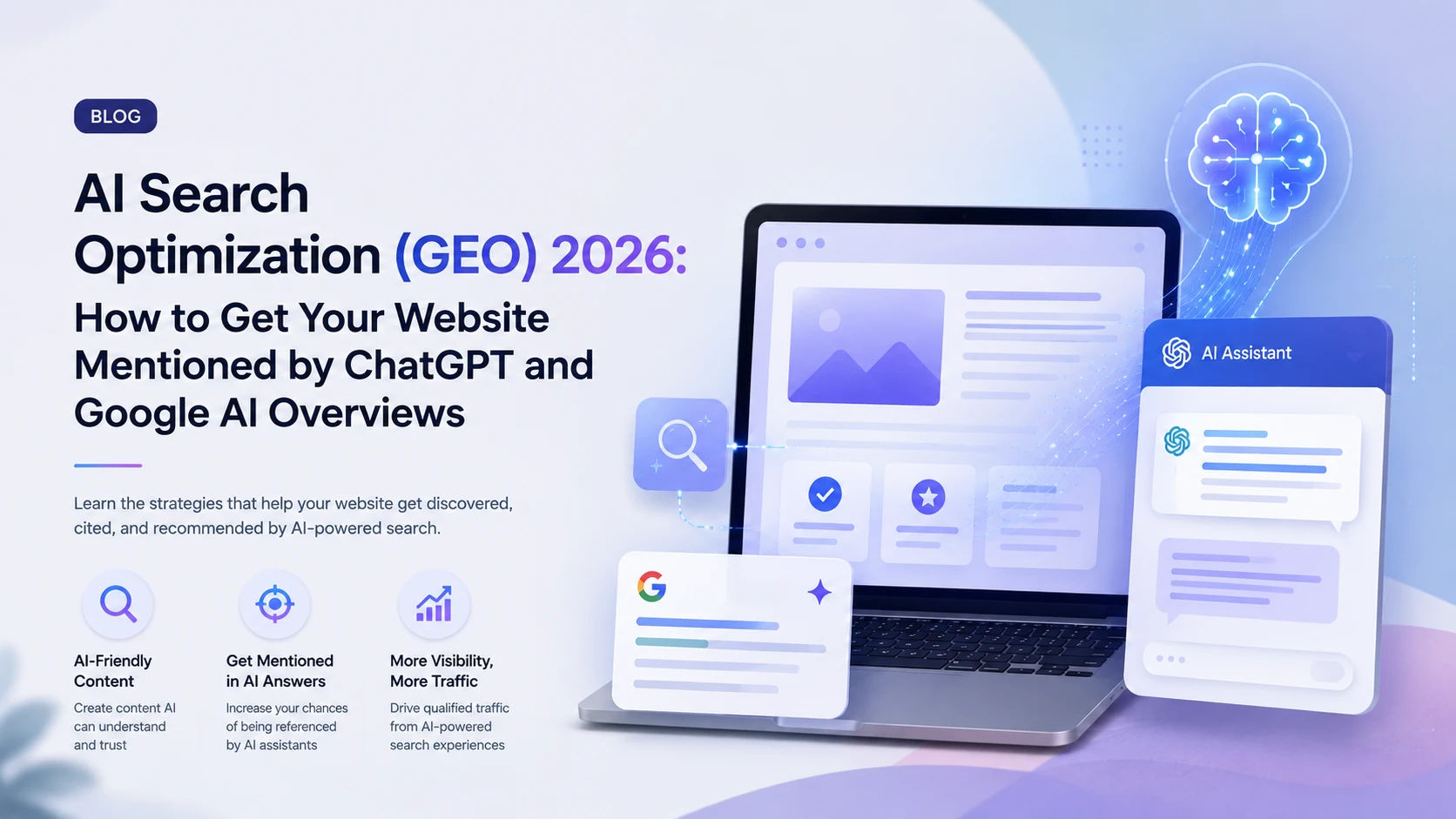
Search behaviour changed faster in the last two years than in the previous decade. A growing share of people are no longer typing a query into Google and clicking ten blue links — they’re asking ChatGPT, Perplexity, or Google’s AI Overviews a question and getting a direct answer, often with a small handful of sources cited underneath.
If your website isn’t one of those cited sources, you’re invisible in a growing part of search — even if you rank on page one the old-fashioned way. This is what people now call AI search optimization, or Generative Engine Optimization (GEO). Here’s what it actually means and how to do it.
GEO vs Traditional SEO — What’s Different
Traditional SEO optimizes for a ranking algorithm that returns a list of links. AI search optimization optimizes for a language model that reads your content, decides whether it’s trustworthy and clear enough to summarise, and then decides whether to cite you at all.
The overlap is bigger than people think — technical SEO fundamentals (site speed, crawlability, structured data) still matter enormously, because AI systems still rely on search indexes to find content in the first place. What’s new is how the content itself needs to be written to get picked up and quoted.
1. Write in Directly Quotable, Fact-Dense Sentences
AI models tend to pull short, self-contained statements — a definition, a statistic, a clear answer to a specific question — rather than long narrative paragraphs. Structuring key facts as standalone sentences near the top of a section (before the elaboration) makes them easier to lift and cite.
Practical tip: For any page you want AI systems to cite, include a tight, 2–3 sentence direct answer immediately under each subheading, then expand afterward for human readers.
2. Answer the Actual Question in the Heading
AI search tools are extremely literal about matching a user’s question to a page’s headings. If someone asks “how much does website development cost in India,” a page with the H2 “How Much Does Website Development Cost in India?” has a far better shot at being pulled into an AI answer than one titled “Our Pricing Philosophy.”
3. Structured Data Still Matters — Maybe More Than Ever
Schema markup (FAQPage, HowTo, Article, Product) helps both traditional crawlers and AI systems understand exactly what a page is about and extract clean, structured facts from it. Google’s own documentation on <a href=”https://developers.google.com/search/docs/appearance/structured-data/intro-structured-data” target=”_blank” rel=”noopener noreferrer”>structured data</a> is still the best reference point, and it applies directly to how AI Overviews source their answers.
4. Build Topical Authority, Not Just Individual Pages
AI systems tend to trust — and cite — domains that demonstrate depth on a topic, not just a single well-optimized page. If your site has one great article about “Shopify vs WordPress” and nothing else related, it’s less likely to be treated as an authority than a site with a cluster of connected, interlinked content covering the same theme from multiple angles.
This is exactly why internal linking between related articles (like we do across our own blog) isn’t just an SEO nicety — it’s becoming a trust signal for AI systems too.
5. Get Cited and Quoted Elsewhere
AI models weigh how often a brand, statistic, or claim is repeated and corroborated across multiple independent sources. Getting mentioned in industry roundups, guest posts, and directories (Google Business Profile, Clutch, GoodFirms for agencies, etc.) still compounds — it’s essentially digital PR for the AI era, not just backlinks for Google.
A Simple GEO Checklist for 2026
- Every important page has a clear, quotable 2–3 sentence answer near the top
- Headings are phrased as real questions people actually search
- FAQ and HowTo schema implemented on relevant pages
- Content is grouped into topic clusters with internal links, not scattered one-offs
- Core Web Vitals and mobile performance are solid (AI crawlers still need to access and render pages)
- Brand is mentioned consistently (same name, same facts) across multiple external sites
FAQs
Does GEO replace traditional SEO? No. It sits on top of solid technical and content SEO. A slow, poorly structured site won’t rank in Google or get cited by AI tools.
Can small businesses actually get cited by ChatGPT or Google AI Overviews? Yes, especially for specific, local, or niche questions where big brands haven’t written detailed content. Specificity often beats domain authority for these narrower queries.
How long does it take to see results from AI search optimization? Similar to SEO — expect weeks to a few months, since it depends on how often AI systems re-crawl and re-index your content.
AI search is only going to take a bigger share of how people find businesses online in 2026 and beyond. If you want your website structured to actually get picked up by both Google and AI assistants, our SEO team can run a full technical and content audit. You might also like our guide on building a complete SEO content strategy with AI.







3 Comments
[…] Related reading: AI search optimization guide […]
[…] Regulatory news like this doesn’t change SEO fundamentals overnight, but it does confirm which direction search visibility is heading. If you’d like your content strategy reviewed for both traditional and AI search visibility, get in touch with our team, or read our full guide on AI search optimization (GEO). […]
[…] The zero-click shift is a genuine structural change in search, not a passing trend — and the businesses adapting well are the ones rethinking what visibility means rather than abandoning SEO altogether. If you’d like your content strategy reviewed for this new search landscape, get in touch with our team, or read our full guide on AI search optimization (GEO). […]