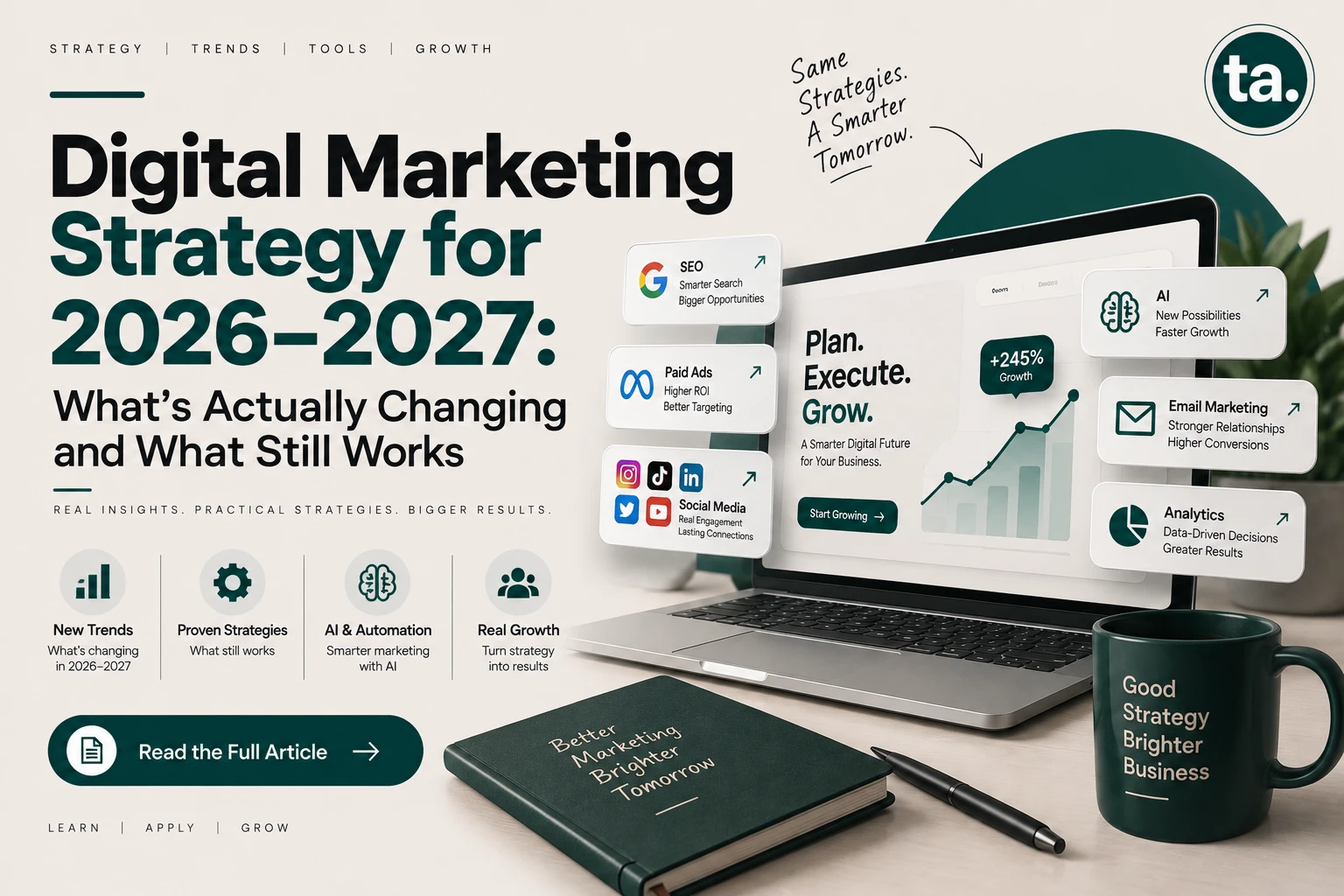
Every year brings a fresh wave of “everything has changed” marketing content, and most of it overstates the case. The truth for 2026–2027 is more useful and more boring: some genuinely important shifts are happening, but the fundamentals of good marketing — understanding your customer, being genuinely useful, and measuring what actually works — haven’t gone anywhere. Here’s a grounded read on both.
What’s Genuinely Changing
AI Has Moved From Novelty to Infrastructure
A large majority of marketing professionals now use AI tools in their daily work, and a substantial share of routine marketing tasks — content drafting, audience segmentation, lead scoring, campaign personalization — can now be meaningfully automated. This isn’t really optional anymore for staying competitive on cost and speed; the businesses lagging on this are simply working harder for the same output.
What hasn’t changed: AI handles the volume and speed, but strategic judgment — what to say, who to say it to, and why it matters — still needs a human directing it. The teams getting genuine productivity gains are the ones using AI to execute a clear strategy faster, not using it as a substitute for having a strategy at all.
Search Behaviour Is Genuinely Fragmenting
A meaningful share of information-seeking has moved beyond traditional search results pages into AI-generated answers, voice assistants, and platform-native search (searching directly within Instagram, TikTok, or Amazon rather than Google). This doesn’t mean traditional SEO is dying — organic search and owned content consistently rank among the highest-ROI marketing channels available — but it does mean visibility now needs to be considered across a wider set of surfaces than a decade ago.
Budget Allocation Has Matured, Not Just Grown
Marketing budgets have stabilized into a fairly even split across search, social, and content investment, rather than concentrating heavily in one channel the way budgets often did a few years ago. This reflects a more disciplined, evidence-based approach to allocation — spend where the data shows returns, not where it’s trendiest.
Mobile Isn’t a Consideration Anymore — It’s the Default
Mobile now accounts for the majority of digital advertising spend and a similarly dominant share of actual traffic and engagement across most industries. Any strategy still designing “for desktop, adapted for mobile” rather than mobile-first is working backward from where actual attention lives.
What Still Works Exactly the Way It Always Has
Genuinely Useful Content Still Outperforms Everything Else Long-Term
Search engines and AI systems alike increasingly reward content that demonstrably helps the reader — specific, accurate, well-organized information — over content built primarily to rank. This has been true for years and remains true; what’s changed is that the tools for spotting shallow, unhelpful content (both algorithmic and AI-based) have gotten considerably better at filtering it out.
Email Remains Quietly One of the Highest-ROI Channels Available
Despite constant predictions of its decline, email marketing continues to post some of the strongest return figures of any digital channel — largely because it reaches an audience that has already opted in, at essentially zero incremental distribution cost per send. It doesn’t get the attention newer channels do, but the numbers consistently justify keeping it as part of a serious strategy.
Trust Signals Still Drive Conversion More Than Clever Messaging
The overwhelming majority of people research reviews before making a purchasing decision, and businesses that actively manage and respond to reviews see measurably stronger customer spending patterns. No amount of clever ad copy substitutes for visible, credible proof that real customers had a good experience.
Consistency Beats Intensity
A concentrated month of marketing effort followed by three months of silence consistently underperforms steady, modest, ongoing effort — across content, email, and paid channels alike. This is unglamorous advice, but it holds up: algorithms, audiences, and trust all reward consistency over sporadic bursts.
A Practical Framework for Building a 2026–2027 Strategy
1. Start from the customer’s actual questions, not your product features. The content, ads, and messaging that perform best consistently answer a real question your ideal customer is genuinely asking, rather than simply describing what you sell.
2. Build a channel mix, not a channel bet. Combine at least one compounding channel (SEO/content) with at least one immediate-results channel (paid search or social) — relying entirely on either extreme leaves a strategy fragile.
3. Invest in first-party data now, not later. As tracking across platforms gets more restricted, your own customer list, email subscribers, and website analytics become increasingly valuable — and increasingly difficult to build quickly if you’ve neglected them.
4. Use AI to increase output quality and speed, not to skip strategic thinking. The businesses getting real value from AI marketing tools are using them to execute a clear plan faster — not letting the tool decide the plan.
5. Measure against actual business outcomes, not vanity metrics. Impressions and follower counts feel good but rarely translate directly to revenue; leads, bookings, and sales are what a strategy should ultimately be judged against.
What This Means Heading Into 2027
The businesses set up well for 2027 are the ones treating digital marketing as an ongoing, measured discipline rather than a series of disconnected campaigns — a website and content foundation that keeps compounding, a paid strategy that’s regularly tested and refined, and a genuine understanding of where their specific customers actually spend attention, updated as that shifts rather than assumed to be static.
FAQs
How much should a small business spend on digital marketing? There’s no universal number, but many established benchmarks suggest allocating a meaningful, sustained percentage of revenue — enough to run real tests and see actual data, rather than a token amount that never generates a large enough sample to learn from.
Is it still worth investing in SEO given how much AI is changing search? Yes — the fundamentals AI systems reward (clear, genuinely useful, well-structured content) largely overlap with what has always made SEO work well; the specific tactics are evolving, but the discipline itself remains highly relevant.
What’s the most common mistake in digital marketing strategy? Chasing whatever channel is trending rather than building a mix based on where a business’s specific customers actually are and what the data shows is actually working.
A genuinely good digital marketing strategy is less about chasing every new trend and more about disciplined execution across the channels that fit your specific business and customers. If you’d like an honest assessment of where your current marketing mix stands, get in touch with our team, or read more on performance marketing and why marketing matters for small business growth.
Related reading: Our SEO services








chat_bubble_outline Leave a Reply