There’s a specific kind of frustration a lot of business owners know well: spending money on ads, seeing some vague activity — impressions, clicks, maybe a few likes — and having no real sense of whether any of it translated into actual revenue. Performance marketing exists to solve exactly that problem. It’s advertising built around a simple principle: you should be able to trace spend to a measurable business outcome, not just visibility.
Here’s a grounded look at what performance marketing actually means in 2026, and how to think about it if you’re evaluating whether — and how — to invest in it.
What Performance Marketing Actually Means
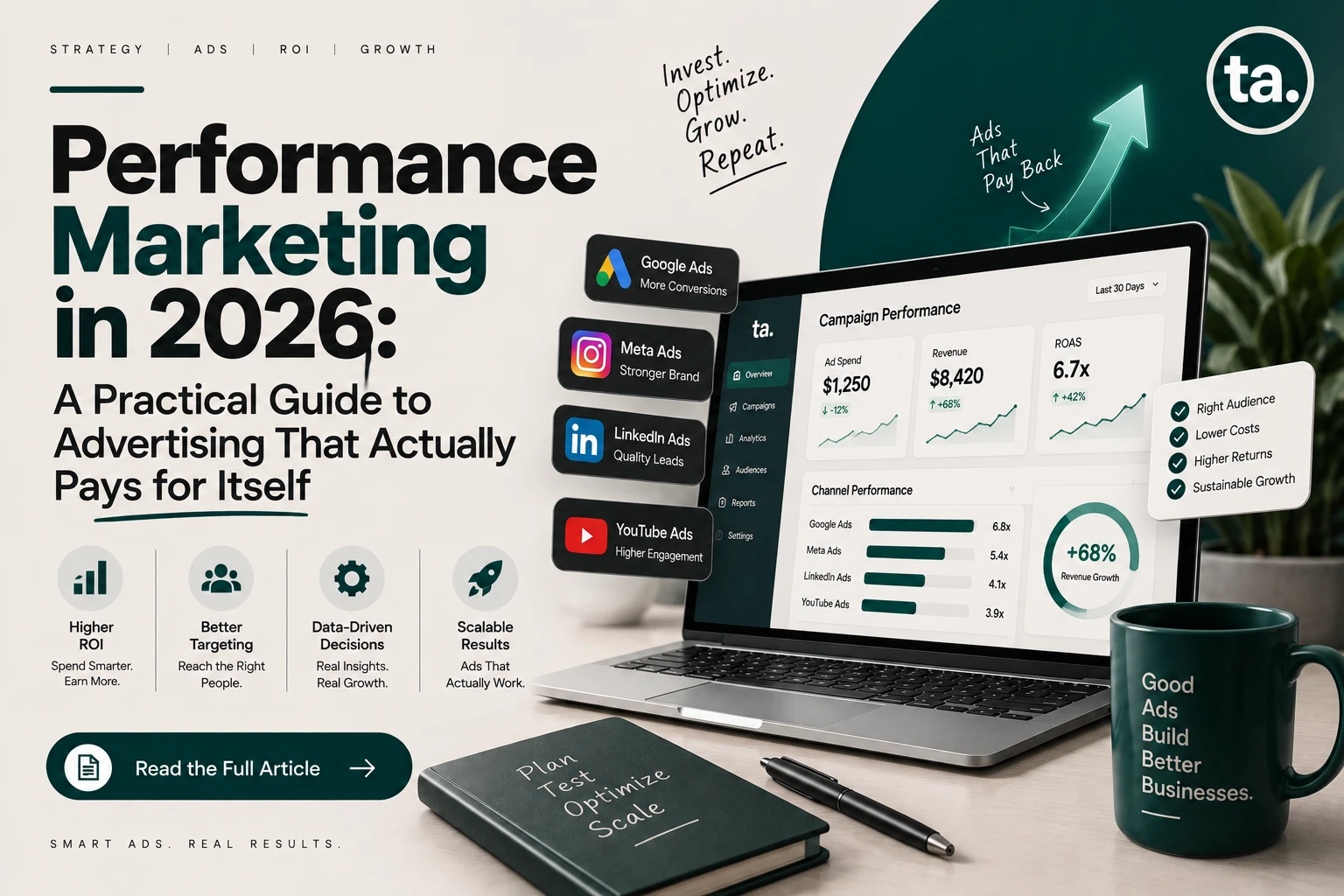
Performance marketing describes a results-driven approach where you pay based on specific, measurable actions — a click, a lead, a sale — rather than simply paying for an ad to be shown. Google Ads, Meta Ads, YouTube Ads, and affiliate marketing programs are the most common channels, and what unites them isn’t the platform, it’s the accountability: every rupee spent should be traceable to a specific outcome, at least in principle.
This is fundamentally different from traditional brand advertising, where the goal is broad awareness and the return is genuinely hard to measure directly. Performance marketing isn’t inherently “better” — awareness advertising still has its place — but for most small and mid-sized businesses with limited budgets, the ability to measure and adjust in near real time is what makes performance marketing the more practical starting point.
The Scale of Where the Industry Actually Is
Global digital advertising spend has moved well past $850 billion in 2026, with performance-based campaigns now controlling a majority share of digital advertising budgets — a clear signal that advertisers overwhelmingly prefer measurable, optimizable spend over guesswork. Mobile alone now accounts for the majority of digital ad budgets, reflecting how thoroughly consumer attention has shifted to phones rather than desktop browsing.
What this means practically: the platforms, targeting tools, and automation available to a small business today are genuinely more sophisticated than what large enterprises had access to just a few years ago. The barrier to running effective performance marketing has dropped — the barrier to running it well has, if anything, gone up, because competition for the same audience attention has intensified.
What’s Actually Changed by 2026
AI-driven optimization is now the default, not a premium feature. Most major ad platforms now use machine learning to continuously adjust targeting, bidding, and creative rotation in real time, often outperforming manual optimization for well-structured campaigns. The skill has shifted from micromanaging bids to designing good inputs — clear goals, quality creative, accurate conversion tracking — that the automation can optimize around effectively.
Attribution has gotten both more important and more complicated. As privacy regulations limit some forms of cross-platform tracking, businesses increasingly need first-party data (their own customer and lead data) to measure performance accurately, rather than relying entirely on platform-reported numbers.
Creative quality has become a bigger performance lever than targeting precision. As automated targeting has matured across platforms, the businesses seeing the strongest returns increasingly differentiate through ad creative and messaging quality rather than audience targeting alone — the targeting is increasingly commoditized; the creative is where an edge is still genuinely earned.
Retargeting remains disproportionately effective. Bringing back visitors who already showed interest — through email, retargeting ads, or on-site personalization — continues to convert at a meaningfully higher rate than cold audience targeting, making it one of the highest-ROI tactics available regardless of overall budget size.
Where the ROI Actually Comes From (Channel by Channel)
Independent marketing research consistently shows organic search and owned content — your website, blog, and SEO — delivering among the strongest overall returns of any marketing channel, precisely because the investment compounds rather than resetting with every new ad cycle. Paid search and social advertising remain highly effective for immediate, trackable results, particularly for businesses with a clear, well-defined offer and audience. Email marketing continues to post some of the highest ROI figures of any individual channel, largely because it targets an audience that has already opted in and shown interest.
The strongest overall marketing programs in 2026 tend to combine these rather than betting entirely on one channel — paid advertising for immediate, measurable pipeline, and SEO/content for compounding long-term traffic that doesn’t disappear the moment ad spend stops.
A Practical Framework for Getting Started
1. Define the actual business outcome before choosing a channel. “More traffic” isn’t a goal — a specific number of qualified leads, bookings, or sales at a target cost is.
2. Get conversion tracking genuinely right before spending seriously. Every major platform’s optimization only works as well as the data feeding it — inaccurate or missing conversion tracking is the single most common reason performance marketing underdelivers.
3. Start with a defined, testable budget on one or two channels, not five. Spreading a limited budget too thin across many platforms usually produces mediocre results everywhere rather than strong results anywhere.
4. Treat the first few weeks as a learning phase, not a verdict. Most ad platforms need a meaningful volume of data before their optimization algorithms perform well — judging a campaign’s real potential too early is a common and costly mistake.
5. Invest in the landing page as seriously as the ad itself. Sending well-targeted, well-optimized traffic to a slow, unclear, or poorly structured landing page wastes a large share of the value the ad spend created in the first place — this is where paid advertising and solid website development directly intersect.
FAQs
How much should a small business budget for performance marketing? This varies enormously by industry and goals, but a common practical approach is starting with a modest, clearly defined test budget over 4–6 weeks, then scaling based on actual measured cost per result rather than a fixed percentage-of-revenue rule.
Is performance marketing better than SEO? They serve different timelines — performance marketing typically produces faster, more immediately measurable results, while SEO builds compounding value that continues generating traffic without ongoing spend. Most mature marketing strategies use both together.
What’s the biggest reason performance marketing campaigns fail to deliver ROI? Inaccurate conversion tracking and sending well-targeted traffic to a weak landing page are the two most common causes — the ad platform itself is rarely the actual bottleneck.
Performance marketing rewards precision — clear goals, accurate tracking, and a landing experience that actually converts the traffic you’re paying for. If you’d like a review of how your current marketing spend is actually performing, get in touch with our team, or explore our SEO services and website development work that support high-converting campaigns.
Related reading: AI search optimization guide




chat_bubble_outline Leave a Reply