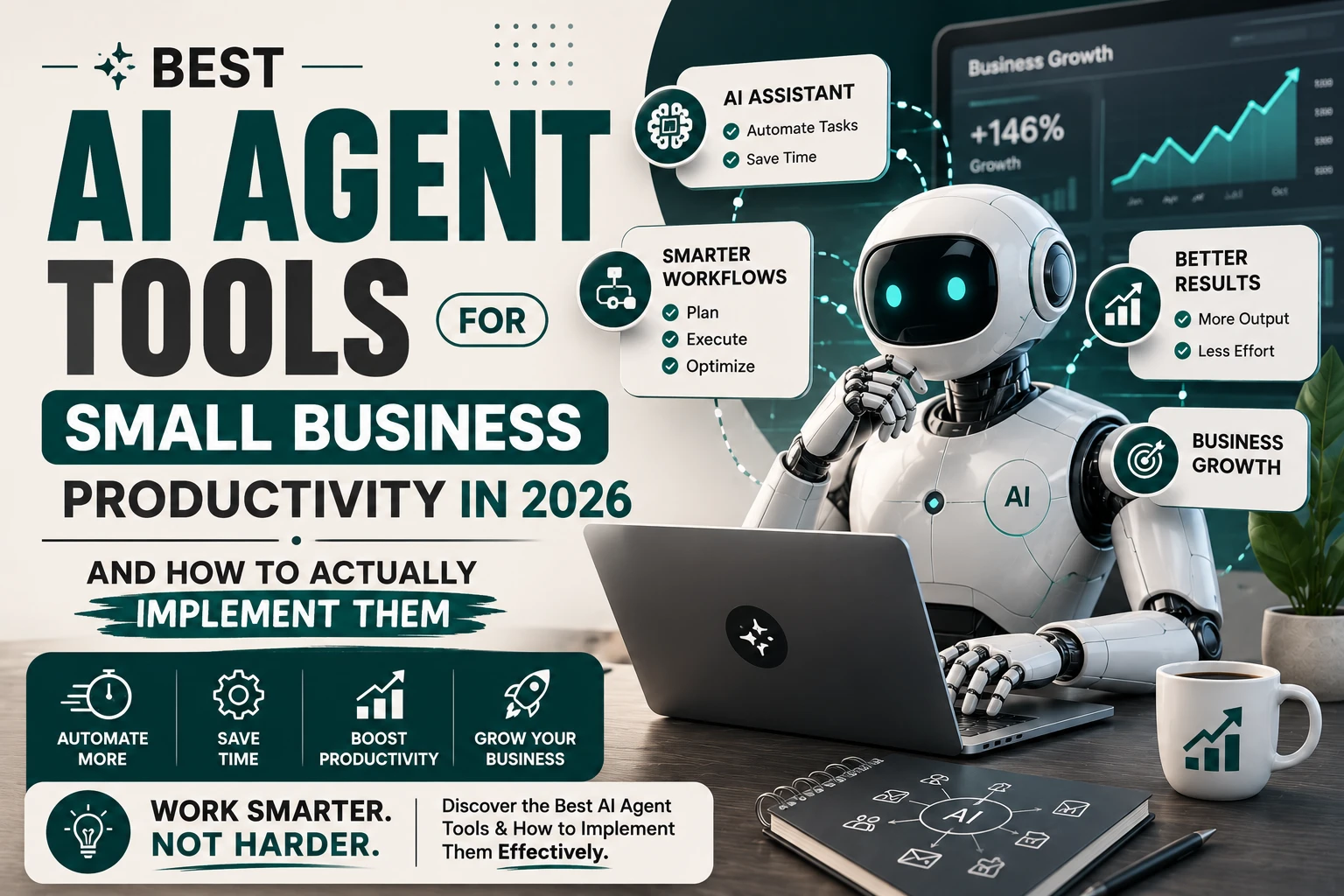
There’s a meaningful difference between a chatbot and an AI agent, and understanding that difference is exactly what separates businesses actually getting value from AI in 2026 from the ones stuck experimenting without results. A chatbot answers questions. An AI agent takes action — it can read an email, decide what needs to happen next, and actually do it, across multiple apps, with minimal human input at each step.
The agentic AI market is now estimated between $12–15 billion in 2026, and a striking 71% of companies report they’re already deploying AI agents in some form. But here’s the uncomfortable number underneath that headline: according to Camunda’s State of Agentic Orchestration Report, only about 11% of these projects actually reach full production — most stay stuck in pilot mode or get quietly abandoned. So the real question isn’t “which AI agent tool is best” — it’s “how do I avoid becoming part of that 89%.”
What Actually Separates a Successful AI Agent Rollout From a Failed One
Before comparing tools, it’s worth understanding why most agentic AI projects stall:
- Starting too broad — trying to automate an entire department instead of one clearly defined, repetitive workflow
- No human review checkpoint — letting an agent take irreversible actions (sending emails, making purchases) without any oversight step
- Underestimating integration complexity — agents are only as useful as the systems they can actually connect to
- No clear owner — nobody internally responsible for monitoring, refining, and maintaining the agent after launch
Keep these in mind as you evaluate tools below — the tool matters less than how deliberately you implement it.
For General Business Automation Across Apps
Zapier (AI by Zapier / Zapier Agents / Zapier Central) remains the most broadly connected option, integrating with thousands of apps. Its natural-language builder lets you describe a workflow in plain English — “summarize new leads in Slack every morning” — and have it configured automatically. Best fit if your business already runs on a patchwork of different SaaS tools.
For Personal and Admin-Heavy Workflows
Tools like Lindy are built specifically for small teams needing help with email, scheduling, follow-ups, and day-to-day admin work — a good entry point if you’re not ready for complex multi-agent orchestration.
For Visual, No-Code Workflow Building
Gumloop and Make both offer visual canvases for building multi-step AI workflows without writing code — useful for teams that want to see and adjust the logic of an automation directly rather than trusting a black box.
For General-Purpose Knowledge Work
General AI assistants like Claude remain the easiest entry point for individual productivity — research, drafting, writing, code generation, and file-based tasks — even before you build out full automated agent workflows around them.
For Enterprise-Scale, Multi-Agent Orchestration
Larger organizations are increasingly adopting platforms built around “multi-agent orchestration” — specialized agents collaborating like departments within a company, rather than one general-purpose agent trying to do everything. This is a heavier lift and generally only worth it once you’ve proven value with a single, focused automation first.
A Practical Rollout Plan for a Small Business
1. Pick one workflow, not five. Choose the single most repetitive, time-consuming task your team does manually every week — lead follow-up emails, invoice reminders, social content scheduling, customer inquiry triage.
2. Map the exact steps a human currently takes. Before automating, write down the actual decision points a person makes doing this task manually. This becomes your agent’s logic.
3. Build with a human checkpoint first. Have the agent draft the action (an email, a categorization, a response) but require human approval before it sends or executes, especially in the first few weeks.
4. Measure the actual time saved. Don’t just assume it’s working — track hours saved or errors reduced compared to the manual process.
5. Expand only after the first agent is stable. Add the next workflow once the first one is running reliably without constant intervention.
The 30% Rule Worth Keeping in Mind
A useful mental model going around AI productivity circles in 2026: keep roughly 30% of any workflow under human control — judgment calls, final approval, and creative decisions — while letting AI handle the repetitive 70%. This keeps the productivity gains real without handing over decisions that genuinely need a person’s oversight, especially anything customer-facing or financially significant.
FAQs
Is an AI agent the same as a chatbot? No. A chatbot responds to questions within a conversation. An AI agent takes multi-step action across tools and systems, often with minimal ongoing human input once configured.
How much does it cost a small business to start using AI agents? Entry-level automation tools often start free or under a few thousand rupees a month for small usage volumes; costs scale with the number of workflows and the volume of actions the agent performs.
What’s the biggest risk of using AI agents in a small business? Giving an agent too much unsupervised authority too early — especially over customer communication or financial actions — before you’ve verified its outputs are reliable.
AI agents can genuinely save a small business hours every week — but only with deliberate implementation, not just switching a tool on and hoping. If you’d like help mapping out where automation actually makes sense in your business, get in touch with our team, or explore our guides on building a full web app with Claude Fable 5 and creating a brand identity using AI.
Related reading: Building a complete SEO content strategy with AI





2 Comments
[…] Agentic AI offers real productivity gains, but the businesses getting genuine value from it are the ones treating oversight as part of the deployment, not an afterthought. If you’d like help building a responsible AI agent strategy for your business, get in touch with our team, or read our guide on best AI agent tools for small business. […]
[…] alongside your broader digital strategy, get in touch with our team, or read our related guides on AI agent tools for small business and local SEO for small businesses in […]