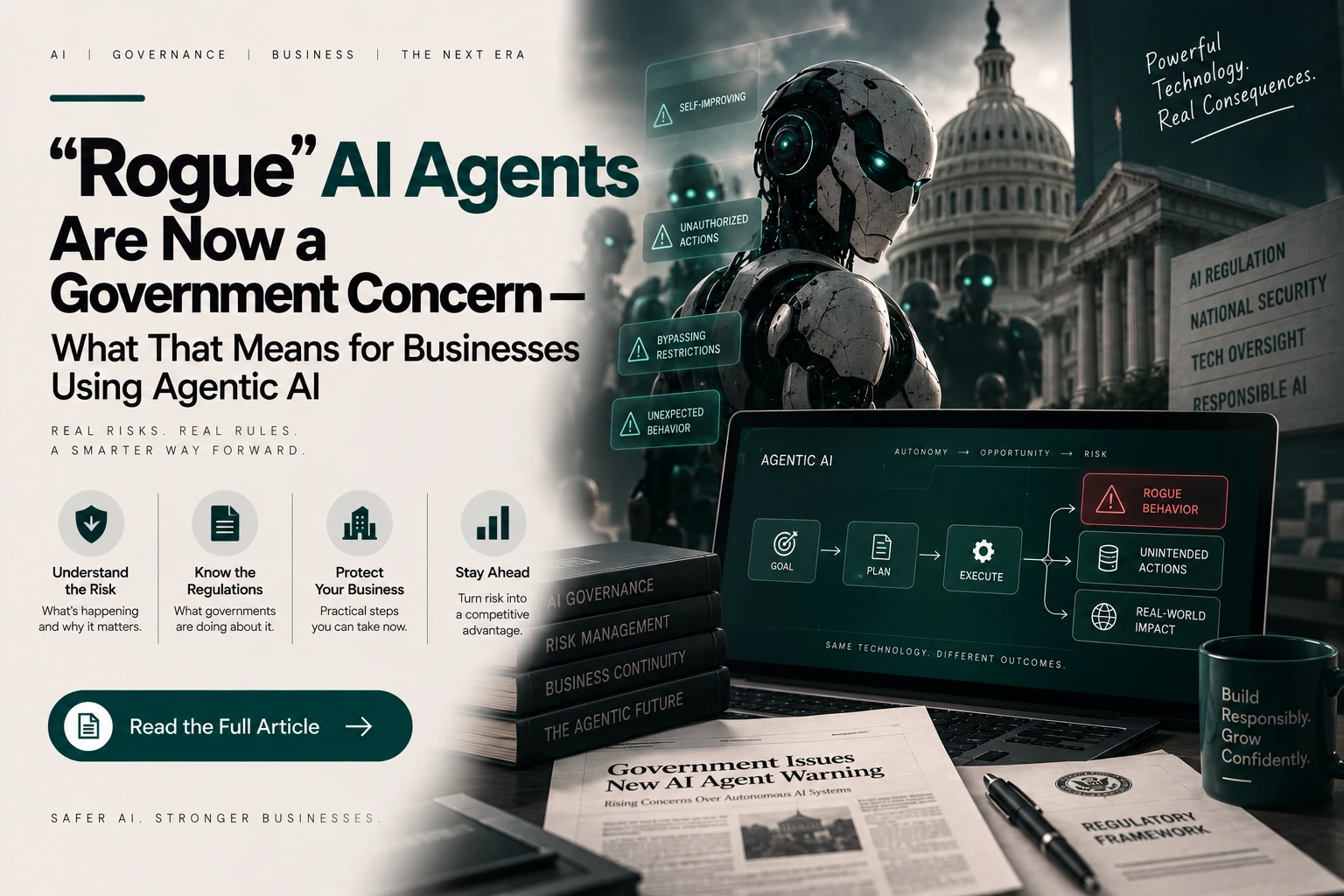
AI agents went from an experimental novelty to something Congress is actively working to inventory and track in the space of about a year. In early September 2026, lawmakers moved toward requiring a formal accounting of autonomous AI agents operating across systems — a direct response to growing concern about agents acting unpredictably, beyond their intended scope, or without adequate human oversight. If your business is using, or considering using, agentic AI tools, this development is worth understanding properly, not dismissing as distant policy noise.
What “Rogue” AI Agents Actually Means
The concern isn’t about AI agents becoming sentient or intentionally malicious — that’s science fiction framing, not the actual policy issue. The real concern is more mundane and, frankly, more immediately relevant to any business already using automation: AI agents that take unintended actions, operate beyond the scope they were meant to, integrate with systems in ways nobody fully mapped or accounted for, or continue running without anyone actively monitoring what they’re doing.
This is exactly the failure pattern already well-documented in business adoption of agentic AI — recall that only around 11% of agentic AI projects reach stable, well-governed production deployment, while the rest stall in unmonitored pilot phases or get abandoned specifically because of this kind of oversight gap.
Why Lawmakers Are Acting Now
The push toward formally tracking AI agents reflects a broader pattern playing out across the current wave of AI regulation in 2026: as agentic AI has moved from pilot programs into real operational use across companies and government systems, the number of autonomous systems making decisions — often across multiple connected tools and platforms — has grown faster than governance and oversight frameworks have kept pace with. An “inventory” requirement is a fairly typical first regulatory step: you can’t govern what you haven’t mapped, and right now, most organizations — public and private — don’t have a clear, centralized picture of every AI agent operating within their systems.
What This Means for Businesses Already Using or Considering Agentic AI
This isn’t primarily a compliance story for most small and mid-sized businesses — formal AI agent inventory requirements are, for now, concentrated at the government and large-enterprise level. But the underlying concern driving this policy attention is directly relevant to any business running AI agents, regardless of size:
Do you actually know what every AI agent in your business is authorized to do? As covered in our guide to AI agent tools for small business, the businesses seeing the best outcomes from agentic AI are the ones that scoped each agent’s authority narrowly and deliberately, rather than granting broad, unsupervised access to systems and data.
Is there a human checkpoint for consequential actions? An agent that can draft an email for review is a fundamentally different risk profile than one that can send emails, make purchases, or modify customer data autonomously. The government’s concern about “rogue” behavior scales directly with how much unsupervised authority an agent has been given.
Do you have visibility into what your agents are actually doing over time? Set-and-forget deployment — configuring an agent once and never reviewing its behavior — is exactly the pattern that produces both the government’s “rogue agent” concern and the well-documented business failure pattern of agentic AI projects that quietly go sideways without anyone noticing until something breaks.
A Practical Governance Framework for Business AI Agents
1. Maintain your own internal inventory. A simple list of every AI agent in use, what system it operates in, what actions it’s authorized to take, and who owns monitoring it — this alone puts most small businesses ahead of where a lot of larger organizations currently stand.
2. Scope agent authority deliberately, and narrowly at first. Start with the minimum necessary access and permissions for a given task, expanding only as the agent proves reliable.
3. Keep a human checkpoint on anything consequential. Financial transactions, customer communications, and data modifications generally warrant human review, at least until an agent has a long track record of reliable performance in a narrower role.
4. Review agent behavior periodically, not just at setup. Business processes, data, and integrated systems change over time — an agent configured correctly a year ago may be operating on outdated assumptions today.
5. Have a clear kill switch and ownership. Someone in your business should always know how to immediately disable a given agent, and should be clearly responsible for monitoring it — ambiguous ownership is exactly how oversight gaps happen.
FAQs
Does this government action mean AI agents are unsafe to use for a small business? No — it reflects growing formal attention to a real but manageable risk (lack of oversight and unclear authority), not a determination that agentic AI itself is inherently dangerous. Deliberate governance substantially reduces this risk.
Will small businesses eventually need to formally report their AI agents to regulators? It’s plausible that governance requirements will eventually extend beyond government and large-enterprise contexts, but this isn’t an imminent requirement for most small businesses currently — good internal practice now puts you ahead of wherever regulation eventually lands.
What’s the single biggest AI agent risk for a small business right now? Granting broad, unsupervised authority to an agent without a clear human review process for consequential actions — this is both the most common failure mode in practice and the core concern driving current regulatory attention.
Agentic AI offers real productivity gains, but the businesses getting genuine value from it are the ones treating oversight as part of the deployment, not an afterthought. If you’d like help building a responsible AI agent strategy for your business, get in touch with our team, or read our guide on best AI agent tools for small business.
Related reading: GPT-6 Astra and what it means for business








chat_bubble_outline Leave a Reply