Loading Article Title...

Web Architect & Digital Strategist at Techno Alig. Passionate about building high-performance websites, e-commerce platforms, and data-driven SEO strategies for growing businesses.
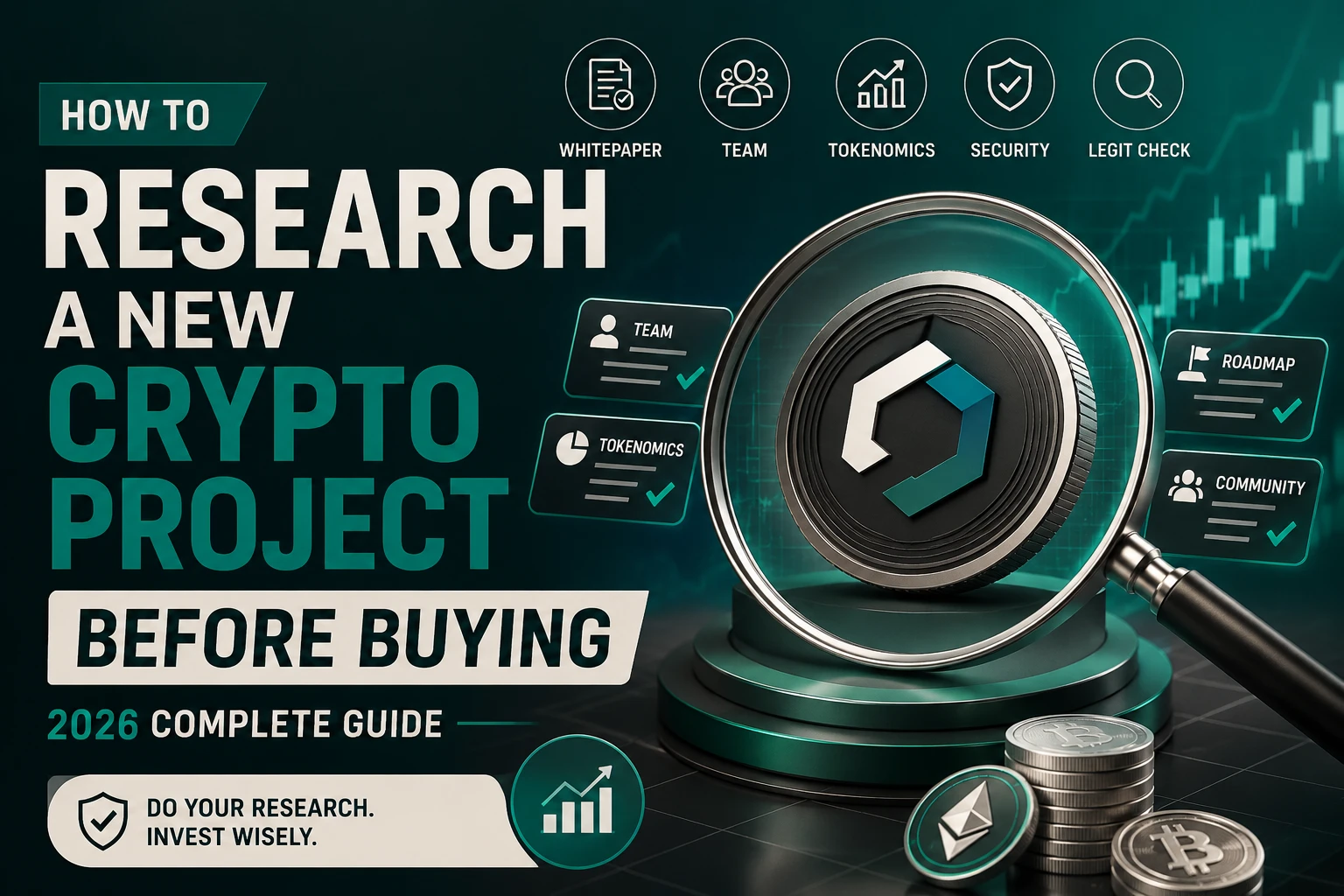
Before putting any money into a new cryptocurrency or blockchain project, every investor needs a repeatable research process. The short version: verify the team is real, read the whitepaper critically, check the tokenomics for red flags, look at on-chain data, confirm an independent security audit exists, and check the community for signs of organic versus manufactured interest. This guide covers each step in detail — including 8 red flags that should send you to the exit immediately.
This is not about finding the next 100× token. It’s about not losing your money to a scam, a poorly designed project, or a team that doesn’t know what they’re doing. In a market where thousands of new tokens launch every week, the ability to research quickly and accurately is the most valuable skill any crypto investor can develop.
Before you look at price charts, tokenomics, or anything else — read the project’s core pitch and ask one question: does this actually need a blockchain?
Many crypto projects exist not because blockchain technology solves a genuine problem, but because launching a token is a fundraising mechanism. The first filter in your research is identifying whether the project is solving a real problem that existing systems cannot solve.
Where to find this information:
Questions to answer at this step:
A project that can’t clearly answer “why blockchain?” in plain language is a yellow flag. It doesn’t automatically mean it’s fraudulent — but it suggests the team may be building on hype rather than substance.
Anonymous teams in crypto are not automatically scams. Some of crypto’s most successful projects (Bitcoin itself) launched without identified founders. But anonymous teams carry higher risk — and for new investors especially, a verifiable team is a meaningful safety signal.
For identified teams:
For anonymous teams:
The research focus shifts from identity verification to track record. Has the anonymous team shipped working code? Is the smart contract audited? Do they have a history of communicating consistently with their community across multiple years?
Anonymous is not the same as untested. An anonymous team with three years of consistent product delivery and clean audits is more trustworthy than an identified team with no track record and a freshly created LinkedIn profile.
The whitepaper is the project’s foundational document. Reading it critically is one of the most effective research tools available.
What a good whitepaper includes:
Red flags in a whitepaper:
The Bitcoin whitepaper is 9 pages. The Ethereum whitepaper is detailed but readable. If a whitepaper is 60 pages of marketing language with no technical substance, that’s a significant warning sign.
Tokenomics refers to the economic design of a token — how many exist, who owns them, when they become available, and how the project plans to create and sustain demand for them.
Key tokenomics metrics to check:
Total supply and circulating supply: Available on CoinMarketCap for listed tokens. A token with 10 trillion in total supply but only 100 million currently circulating has a massive inflation risk as more tokens are released over time.
Token allocation breakdown: How is the total supply distributed?
| Allocation | Warning Threshold |
| Team/Founders | Concern if >20%; red flag if >40% |
| Early investors / VCs | Concern if >30% with no lockup |
| Community/Public | Healthy if >40% |
| Treasury/Ecosystem | Fine if governed transparently |
A project where the founding team controls 50% of the token supply has the ability to dump their holdings and destroy the token price — with no technical barrier preventing them from doing so.
Vesting schedules and lock-ups: When can the team and early investors sell their tokens? Projects with no vesting period or very short lock-ups (less than 12 months) carry higher insider-selling risk. Look for cliff vesting (tokens locked for a set period before any can be sold) rather than immediate or linear vesting from day one.
Unlock calendar: Check if any major token unlocks are upcoming. Sites like TokenUnlocks.app and DeFiLlama provide unlock schedules for major projects. A $100 million unlock in the next 30 days is relevant information before buying.
Every Monday: new project highlights, on-chain flags, and what’s moving in crypto.
Subscribe to Techno Alig’s Free Crypto Newsletter →
No hype. Just research.
For any crypto project that is live on a blockchain, the on-chain data tells you things no marketing document can fake.
Tools to use:
What to look for:
Wallet concentration: How many wallets hold how much of the token? If the top 10 wallets hold 80% of the token supply, the project is effectively controlled by a handful of actors who can move the market with a single transaction. A healthy distribution shows hundreds or thousands of addresses holding meaningful amounts.
Transaction history and activity: Is the network actually being used? Growing daily transaction counts and unique addresses suggest organic adoption. Flat or declining on-chain activity while the marketing team posts about “explosive growth” is a contradiction worth investigating.
Liquidity depth: If the token is traded on a DEX, how deep is the liquidity pool? A token with $200,000 in total liquidity can be price-manipulated easily. Thin liquidity is both a manipulation risk and a warning sign that institutional capital has not shown confidence.
Smart contract age and activity: How long has the smart contract been deployed? Has it been upgraded? A contract deployed last week with no prior version has no track record. Contracts that have been live for 12+ months under heavy usage are meaningfully more battle-tested.
A smart contract audit is when an independent security firm reviews the project’s code for vulnerabilities before (or after) deployment. For any DeFi protocol, token, or smart-contract-based application, the presence of a reputable audit is a baseline safety requirement — not a guarantee, but a necessary condition.
Reputable audit firms to recognize:
Where to find audit reports: The project should link to the full audit report — not just claim one exists. Read the executive summary: how many critical, high, medium, and low vulnerabilities were found? Were all critical and high issues resolved?
A project claiming “our code has been audited” without linking to the full report is not demonstrating transparency.
Warning: An audit report does not guarantee safety. Audits review code as written — they cannot predict all future vulnerabilities or protect against economic exploits that operate within the rules of the protocol. A recent $200 million DeFi hack involved code that had been audited by two firms.
The character of a crypto project’s community is one of the most reliable non-technical signals available to researchers.
Healthy community signals:
Unhealthy community signals:
The SEC’s guidance on crypto assets in 2026 continues to evolve, but one principle remains constant for US investors: assets that function like investment contracts — where you invest expecting profits from others’ efforts — may be subject to securities law regardless of how they’re labeled.
Beyond the legal landscape, the practical implication for US investors is this: the due diligence process described in this guide is not optional if you’re investing meaningful capital. The crypto market in 2026 still contains thousands of fraudulent or poorly designed projects alongside genuinely innovative ones. The difference between them is often discoverable in 30–60 minutes of structured research.
Use this checklist every time. Even for projects that look credible at first glance.
Print this or save it. Use it before every new investment:
Subscribe to Techno Alig Crypto Weekly →
How do you research a cryptocurrency before investing? Research a cryptocurrency by verifying the team’s identity and track record, reading the whitepaper critically, analyzing tokenomics (total supply, team allocation, vesting schedules), checking on-chain wallet concentration using blockchain explorers, confirming a reputable independent security audit exists, and evaluating the authenticity of the community.
What is DYOR in crypto? DYOR stands for “Do Your Own Research” — a widely used phrase in crypto communities reminding investors to independently verify claims before investing, rather than relying on social media hype, influencer recommendations, or community enthusiasm. This guide provides a structured framework for doing that research effectively.
What are the biggest red flags when researching a crypto project? The most serious red flags are: guaranteed return promises, team tokens with no vesting lock-up, no independent smart contract audit, anonymous team with no track record or shipped product, copied whitepaper sections, and high-pressure urgency tactics around purchase deadlines.
What is a crypto whitepaper and why does it matter? A whitepaper is the foundational document of a crypto project that explains the problem it solves, how its technology works, the token economics, and the roadmap. It is the primary source document for evaluating a project’s technical credibility and team competence. A vague, plagiarized, or marketing-heavy whitepaper with no technical substance is a significant warning sign.
How do I check if a crypto project has been audited? The project should publicly link to a full audit report from a reputable firm such as Trail of Bits, OpenZeppelin, Halborn, or Quantstamp. Search “[project name] + audit” to find the report. Read the executive summary to see how many critical and high vulnerabilities were found and whether they were resolved. A project that only claims an audit without linking to the report is not demonstrating meaningful transparency.
Sources:

If you’re looking for a reliable Web Developer in Aligarh, look no further than Techno Alig. Contact us today to discuss your project and take the first step towards establishing a powerful online presence.


No spam, notifications only about new offers, services.
chat_bubble_outline Leave a Reply