Loading Article Title...


Web Architect & Digital Strategist at Techno Alig. Passionate about building high-performance websites, e-commerce platforms, and data-driven SEO strategies for growing businesses.
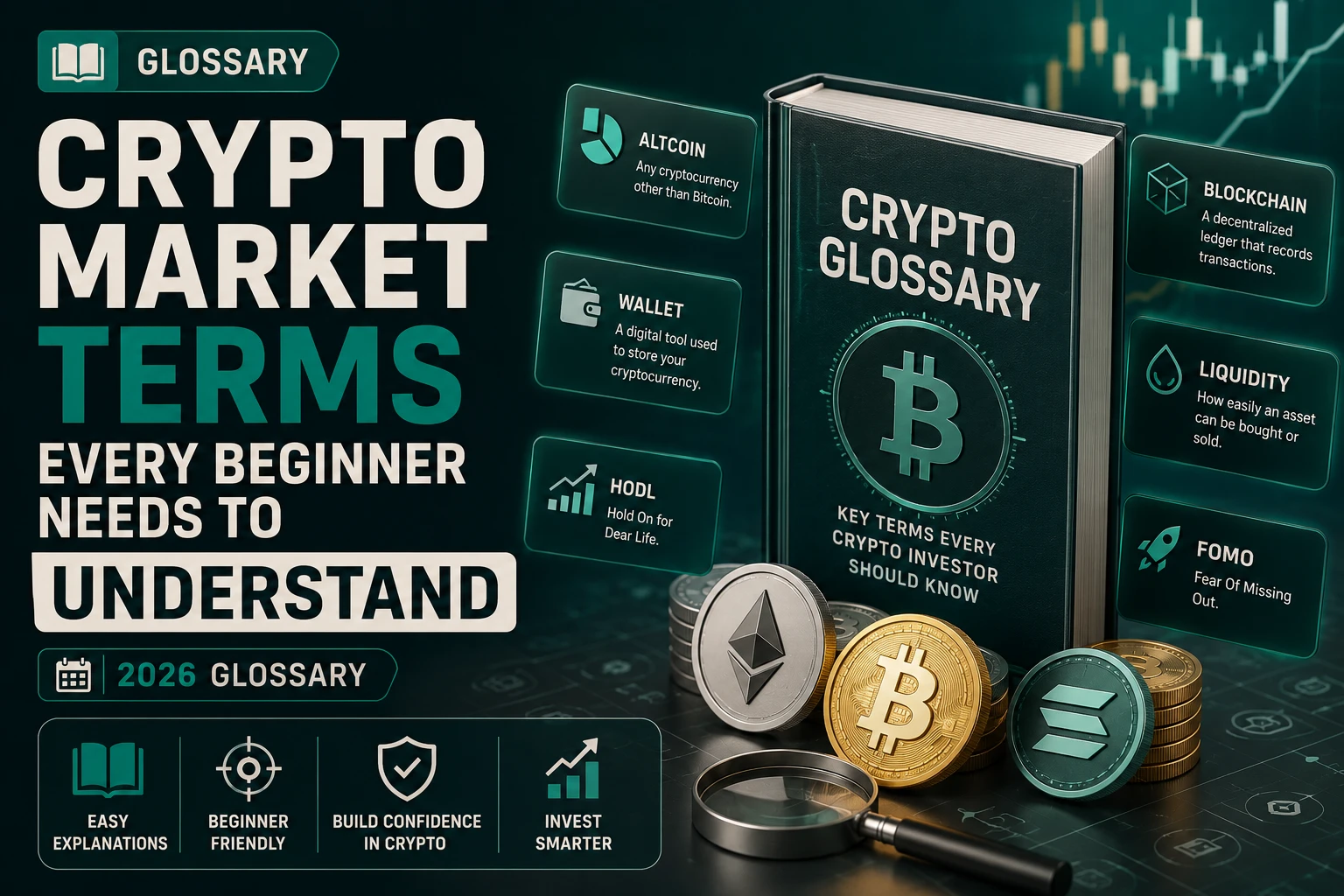
If you’ve ever read a crypto article and felt like you needed a separate dictionary just to follow along, this is for you. This glossary covers 40+ essential crypto terms in plain English — the words that appear in every Bitcoin headline, Ethereum update, and DeFi discussion — explained the way a knowledgeable friend would explain them, not the way a textbook would.
No jargon inside the explanations. Real-world examples throughout. Bookmark this page and come back whenever you hit a word you don’t recognize.
Bitcoin is the first and largest cryptocurrency by market value. Created in 2008 by the pseudonymous Satoshi Nakamoto and launched in January 2009, it is a digital currency that operates without a central authority like a bank or government. The Bitcoin whitepaper describes it as “a peer-to-peer electronic cash system.” As of August 2026, Bitcoin has a market capitalization of approximately $1.30 trillion.
A blockchain is a type of database where data is stored in “blocks” that are linked together chronologically in a “chain.” Once data is written to a block and confirmed by the network, it cannot be altered without changing all subsequent blocks — making it extremely difficult to tamper with. This structure provides the foundation for trust in cryptocurrency transactions without requiring a central authority to verify them.
Simple analogy: Think of a blockchain as a shared Google Doc that thousands of people can read simultaneously, but where no one can delete or edit old entries — only add new ones. Everyone sees the same version.
A cryptocurrency is a digital asset that uses cryptography to secure transactions and control the creation of new units. Unlike traditional currencies issued by governments (called “fiat currency”), most cryptocurrencies operate on decentralized networks. Bitcoin, Ethereum, and Solana are all cryptocurrencies.
An altcoin is any cryptocurrency other than Bitcoin. The word comes from “alternative coin.” Ethereum, Solana, Cardano, XRP, and thousands of smaller tokens are all altcoins. Some altcoins serve specific technical purposes; others are primarily speculative.
These terms are often used interchangeably but have a technical distinction:
Market cap is the total value of all coins or tokens in circulation. It is calculated as:
Market Cap = Current Price × Circulating Supply
If a token trades at $10 and there are 100 million tokens in circulation, the market cap is $1 billion. CoinMarketCap tracks market cap for all major cryptocurrencies.
Market cap is useful for comparing the relative size of different cryptocurrencies — but it can be misleading for smaller tokens where the circulating supply is a fraction of the total supply.
A large gap between circulating supply and total supply indicates significant future inflation risk — more tokens will enter the market over time, potentially diluting the value of existing tokens.
The total value of a cryptocurrency bought and sold in a given period (usually 24 hours). High volume relative to market cap suggests active, liquid trading. Low volume can indicate price manipulation risk or declining interest.
Liquidity describes how easily an asset can be bought or sold without significantly affecting its price. A liquid asset (like Bitcoin) can be bought or sold in millions of dollars without moving the market much. An illiquid token (small market cap, thin trading) might drop 30% if one holder sells a large position.
Get our weekly plain-English crypto briefing — prices, key terms explained in context, and what’s happening in Bitcoin, Ethereum, and Solana.
Subscribe to Techno Alig’s Free Crypto Newsletter →
Originally a typo for “hold,” HODL became one of crypto’s defining terms. It refers to the strategy of holding a cryptocurrency long-term rather than selling during market downturns. A HODLer is someone who does not react to short-term price movements.
In context: “Despite Bitcoin dropping from $126,000 to $64,000, long-term HODLers have not been selling — on-chain data shows fewer than expected coins moving to exchanges.”
FOMO describes the anxiety of missing a price run-up — and the irrational buying decisions it can cause. A FOMO buyer purchases an asset after it has already risen significantly because they fear the rally will continue and they’ll be left behind. FOMO-driven purchases are one of the most common ways investors buy at the top of a market cycle.
FUD refers to negative sentiment, news, or narratives that cause fear in the market — sometimes organic, sometimes deliberately spread to drive prices down. “That article is pure FUD” means the author believes the negative claims are exaggerated or false.
Leverage means using borrowed money to amplify potential returns — and losses. A 10× leveraged position means a 10% price move produces a 100% gain or loss. Leverage is extremely dangerous for beginners and is responsible for the majority of large individual trading losses in crypto.
A crypto wallet is software or hardware that stores the cryptographic keys needed to access and transact with cryptocurrency. Important distinction: a wallet does not actually “hold” your cryptocurrency — your coins exist on the blockchain. The wallet holds the private key that proves ownership and enables transactions.
Hot wallet: Connected to the internet (apps, exchanges). Convenient but higher security risk. Cold wallet: Offline hardware device (Ledger, Trezor). Less convenient, significantly more secure for large amounts.
Gas fees are the transaction costs paid to validators on a blockchain network to process and confirm transactions. On Ethereum, fees are paid in ETH. On Solana, fees are paid in SOL. The fee amount varies with network congestion — higher traffic means higher fees.
2026 context: Ethereum’s gas fees dropped from over $2 per transaction in 2024 to below $0.02 by March 2026 — a 99% reduction following network upgrades.
The method by which a blockchain network agrees on the validity of transactions.
DeFi refers to financial services — lending, borrowing, trading, earning interest — built on blockchain networks and governed by smart contracts rather than banks or financial institutions. Anyone with a crypto wallet can access DeFi protocols. Ethereum’s DeFi overview covers the ecosystem in detail.
2026 context: Ethereum’s DeFi TVL (Total Value Locked) stands at approximately $41.77 billion as of this week.
TVL is the total amount of cryptocurrency deposited in a DeFi protocol. It’s the primary metric for measuring the size and adoption of a DeFi application. Track TVL data across all protocols at DeFiLlama.
A DEX is a crypto exchange that operates via smart contracts, without a company holding your funds or controlling the order book. You trade directly from your wallet. Uniswap (Ethereum) and Jupiter (Solana) are major DEXs.
2026 context: Solana’s DEX volume exceeded the combined volumes of Bybit, Coinbase, and Kraken this week — the fifth consecutive week of this milestone.
An AMM is the mechanism most DEXs use to enable trading without a traditional order book. Instead, liquidity providers deposit tokens into a “pool,” and prices are set algorithmically based on the ratio of assets in the pool. You trade against the pool, not against another user.
A smart contract is a self-executing program stored on a blockchain that automatically carries out predefined actions when certain conditions are met. “If X payment is received, automatically release Y tokens to address Z.” They are the foundation of DeFi, NFTs, and most crypto applications.
A stablecoin is a cryptocurrency designed to maintain a stable value, typically pegged to the US dollar at a 1:1 ratio. USDC and USDT are the largest stablecoins. They are widely used in DeFi because they allow users to participate without exposure to price volatility.
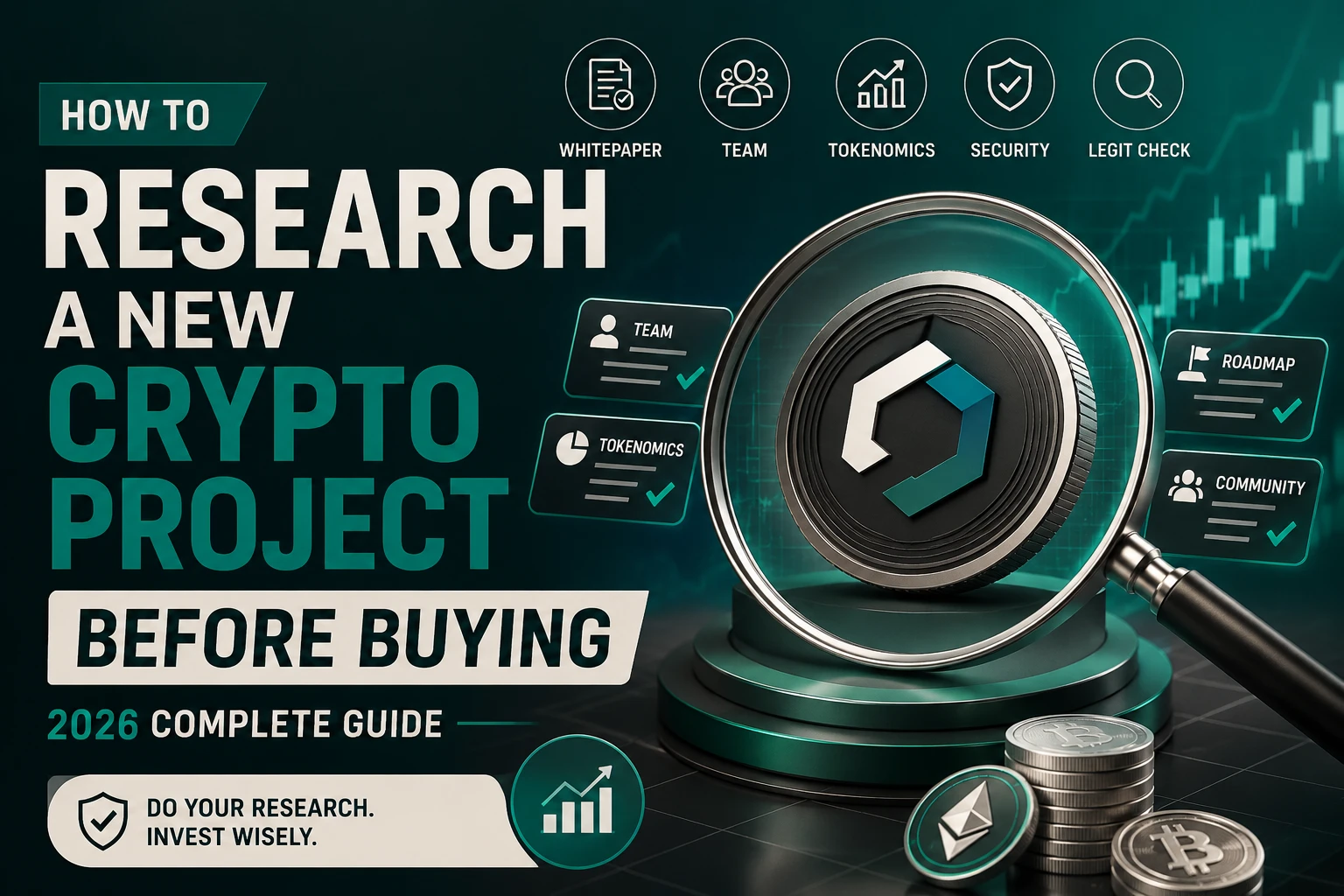
A reminder that individuals should independently verify information before making investment decisions rather than relying on tips, influencers, or community hype. This guide’s companion article on how to research a crypto project provides a structured framework for doing exactly this.
A whale is an individual or entity that holds a large enough amount of a cryptocurrency to meaningfully influence the market when they buy or sell. In Bitcoin, a wallet holding more than 1,000 BTC is commonly considered a whale. Tracking whale movements is a common on-chain research technique.
A rug pull is a type of exit scam where the creators of a crypto project (typically a token or DeFi protocol) abandon it and withdraw all investor funds after building up interest and liquidity. The term comes from the phrase “pulling the rug out from under” investors. Rug pulls range from deliberate fraud to simply abandoning a project without refunding investors.
Tokenomics refers to the economic design of a token — including total supply, distribution, vesting schedules, inflation rate, and mechanisms for value capture. Good tokenomics aligns incentives between founders, investors, and users. Poor tokenomics (e.g., team can sell immediately, unlimited supply) is one of the most reliable predictors of long-term price decline.
Vesting refers to the schedule by which team members or early investors’ token allocations become available to sell. A “12-month cliff with 24-month linear vesting” means no tokens can be sold for the first 12 months, then tokens are released gradually over the following 24 months. Strong vesting schedules align team incentives with long-term project success.
Every Monday: What happened in Bitcoin, Ethereum, and Solana — explained in plain English for investors at every level.
| Term | Plain English Definition |
| HODL | Hold your crypto long-term, don’t panic-sell |
| ATH | The highest price a crypto has ever reached |
| Market Cap | Total value of all coins × current price |
| Gas Fee | Transaction cost paid to use a blockchain network |
| DeFi | Financial services on blockchain, no bank required |
| FOMO | Buying because you fear missing a price run-up |
| Rug Pull | Exit scam where founders take funds and disappear |
| Whale | Large holder who can move markets with one trade |
| DYOR | Do Your Own Research before investing |
| TVL | Total Value Locked — how much is deposited in a protocol |
What does HODL mean in crypto? HODL is a misspelling of “hold” that became crypto slang for the strategy of holding cryptocurrency long-term regardless of market volatility. A HODLer does not sell during market downturns and believes in the long-term value of their holdings.
What is market cap in cryptocurrency? Market capitalization (market cap) in crypto is calculated by multiplying the current price of a cryptocurrency by its circulating supply. It represents the total market value of all tokens currently in circulation and is the primary metric for comparing the relative size of different cryptocurrencies.
What is DeFi in simple terms? DeFi (Decentralized Finance) refers to financial services — lending, borrowing, trading, and earning interest — built on blockchain networks and operated by smart contracts rather than banks. Anyone with a crypto wallet and internet connection can use DeFi protocols without needing a bank account or identity verification.
What is a gas fee in crypto? A gas fee is the transaction cost paid to validators on a blockchain network to process and confirm a transaction. Gas fees vary based on network congestion — when the network is busy, fees are higher. On Ethereum, fees dropped from over $2 in 2024 to below $0.02 by 2026 following network upgrades.
What is a rug pull in crypto? A rug pull is a type of crypto scam where project creators build up investor interest and liquidity, then suddenly abandon the project and withdraw all funds — leaving investors with worthless tokens. It is one of the most common forms of crypto fraud, particularly in new DeFi protocols and memecoins.
Sources:

If you’re looking for a reliable Web Developer in Aligarh, look no further than Techno Alig. Contact us today to discuss your project and take the first step towards establishing a powerful online presence.

No spam, notifications only about new offers, services.
chat_bubble_outline Leave a Reply