Web Architect & Digital Strategist at Techno Alig. Passionate about building high-performance websites, e-commerce platforms, and data-driven SEO strategies for growing businesses.
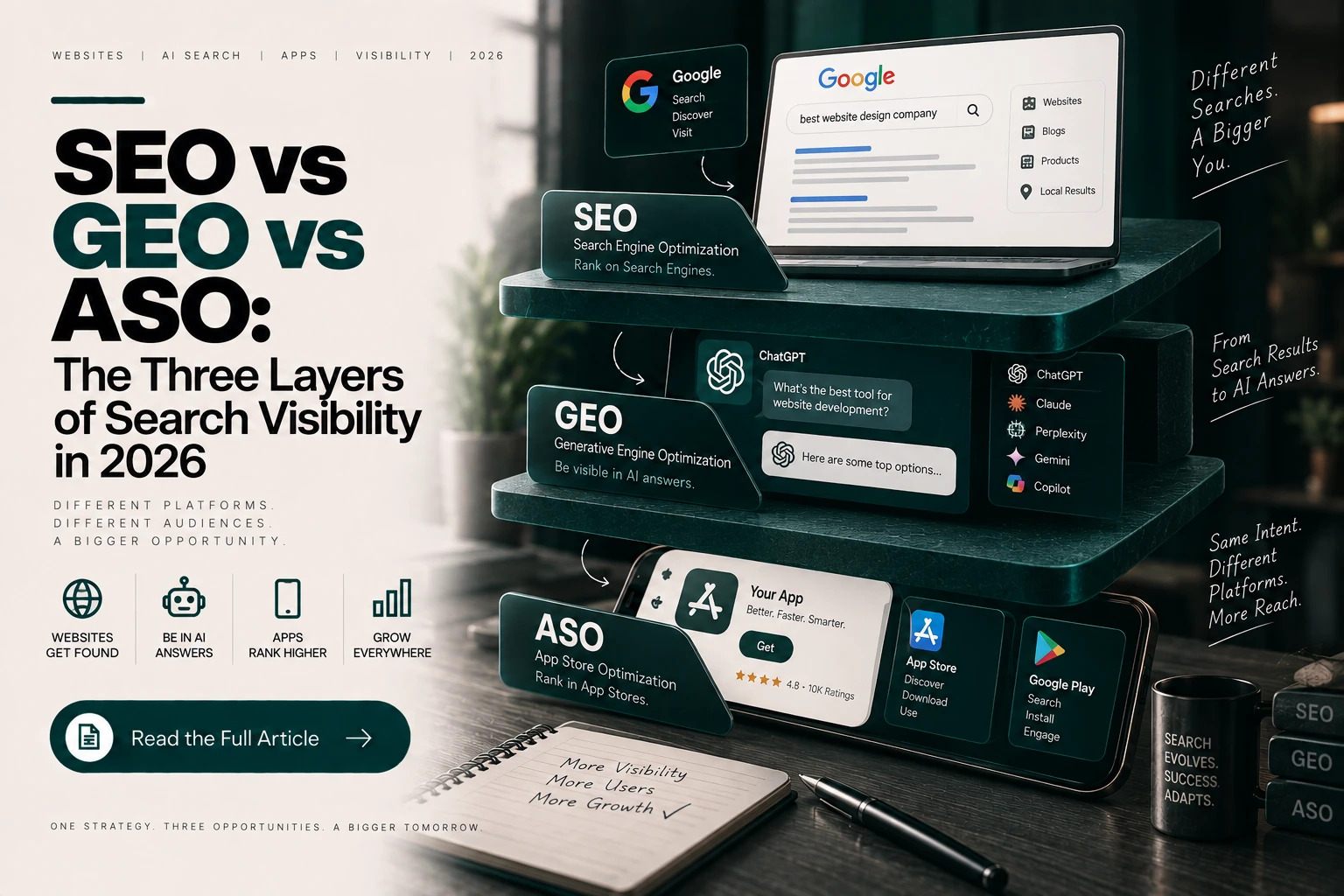
SEO vs GEO vs ASO: The Three Layers of Search Visibility in 2026
Search visibility used to mean one thing: where you appear in Google’s results. In 2026 it means three distinct things operating simultaneously, and a business can be excellent at one while being invisible in another. Here’s how the three layers actually differ, and which one your business should be working on first.
The One-Line Difference
SEO wins rankings, GEO wins citations, and ASO wins actions. Search engine optimization gets you positioned in results, generative engine optimization gets you quoted in AI answers, and agentic search optimization gets an AI agent to actually complete a task on your site.
That framing is the fastest way to understand why the three can’t substitute for each other. A site can rank first in Google, be cited in every relevant ChatGPT answer, and still fail completely the moment an agent tries to use its contact form.
What Is SEO?
Search engine optimization is the practice of structuring a website and its content so search engines rank it well in organic results. It covers technical health, content relevance, and authority signals like backlinks.
SEO remains the foundation rather than a legacy layer. Agents and AI systems still discover websites through search indexes, which means a site invisible to conventional search is usually invisible to the layers above it too. Nothing about the newer disciplines removes the need for crawlability, site speed, clear information architecture, and content that genuinely matches search intent.
What Is GEO?
Generative engine optimization is the practice of structuring content so AI systems cite it when generating answers. It focuses on being quoted and attributed in AI-generated responses rather than on ranking position.
GEO became urgent because of how much search behaviour shifted. Google’s AI Mode passed one billion monthly users, and independent research has found a large majority of AI Mode searches end without any click to an external website. Being cited in that answer, even without a click, is a genuine form of visibility — and Google has begun rolling out reporting in Search Console specifically to show impressions from AI features.
The techniques differ from classic SEO in emphasis rather than in kind: quotable self-contained answers near the top of sections, headings phrased as real questions, dense factual specificity, and structured data that makes claims easy to extract accurately.
What Is ASO (Agentic Search Optimization)?
Agentic search optimization is the practice of structuring a website so autonomous AI agents can complete tasks on it, not merely read it. It covers the full task loop — the forms, calendars, carts, and checkouts that agents must operate to finish the job their user gave them.
The term entered common marketing use in April 2026, when Adobe introduced it as the third layer of the brand visibility stack following its acquisition of Semrush. The framing stuck because it named a real gap that practitioners were already hitting.
Google confirmed the direction on 20 March 2026 by adding a new Google-Agent user agent to its official documentation, and the W3C published the WebMCP browser standard — enabling websites to expose structured tools directly to AI agents — in February 2026.
Comparison Table
SEO
GEO
ASO
Goal
Rank in results
Get cited in AI answers
Get transacted with by agents
Audience
Search crawlers
Language models
Autonomous browsing agents
Success metric
Position, organic clicks
Citation frequency, AI impressions
Agent-completed actions
Key assets
Content, links, technical health
Quotable structure, factual density
Machine-readable data, usable forms
Core files
robots.txt, sitemap.xml
Structured data (JSON-LD)
llms.txt, WebMCP, OpenAPI
Maturity
Established
Emerging, fast-moving
Early, standards still forming
Priority for most SMBs
First
Second
Third
Which Layer Should Your Business Work On First?
Work on them in order. SEO is the floor — agents still discover sites through search indexes, so weak SEO undermines both layers above it. GEO is the practical next step for most businesses. ASO matters most for businesses with booking, quoting, or purchasing flows.
That sequencing holds for the large majority of small and mid-sized businesses. The exceptions are worth naming: an ecommerce store or a booking-driven service business has a stronger case for moving to ASO earlier, because agent-completed transactions would be directly valuable rather than theoretical.
Do the Three Layers Conflict With Each Other?
No. They overlap substantially. Structured data, semantic HTML, fast and stable rendering, and clear factual content improve performance across all three layers simultaneously.
This is the most reassuring thing about the current landscape, and it’s genuinely true rather than a consolation. Clean JSON-LD helps search engines understand your page, helps AI systems cite you accurately, and gives agents the structured facts they compare against. Layout stability helps human users, feeds Core Web Vitals, and prevents agents from clicking the wrong element. Very little of this work is layer-specific.
The narrower, layer-specific investments — an llms.txt file for agent discovery, WebMCP tools for agent interaction, question-formatted headings for AI citation — are additions on top of a shared foundation, not competing priorities.
How Do You Measure Each Layer?
Each layer has its own emerging measurement surface. SEO uses conventional rank tracking and Search Console. GEO increasingly uses Search Console’s AI feature reporting and citation monitoring. ASO uses server log analysis of agent user agents and agent-readiness scanners.
Microsoft’s Bing Webmaster Tools added AI Performance reporting in February 2026, showing impressions and clicks from Copilot and Bing AI answers — useful as a first-party proxy for AI visibility across the Microsoft ecosystem, which includes ChatGPT since it draws on Bing’s index.
For the agentic layer, the practical measurement is still fairly manual: check server logs for known agent user agents, run Chrome’s Lighthouse Agentic Browsing audit, and use agent-readiness scanners to identify structural gaps.
FAQs
Is SEO becoming obsolete because of GEO and ASO? No. SEO is the discovery foundation both newer layers depend on, since agents and AI systems still locate websites through search indexes. Its definition of success is expanding beyond clicks, but the underlying discipline remains essential.
Can a small business realistically work on all three layers? Yes, because the foundational work overlaps heavily. Most of what improves agent readiness — structured data, semantic markup, layout stability — also serves SEO and GEO, so the marginal cost of covering all three is lower than it appears.
Is ASO the same as App Store Optimization? No, though the acronym collides. In this context ASO means agentic search optimization. App Store Optimization is an unrelated mobile app discipline that has used the same abbreviation for years.
How quickly is the agentic layer actually growing? Quickly. AI agent and agentic-browser traffic was reported up 7,851% year over year in 2026, and automated traffic passed human traffic for the first time in June 2026 at 57.3% of web page requests.
Three layers sounds like three times the work, and it isn’t — most of the foundation is shared. The genuine change is that “are we visible?” now has three different answers, and most businesses have only ever measured the first one.
If you’re looking for a reliable Web Developer in Aligarh, look no further than Techno Alig. Contact us today to discuss your project and take the first step towards establishing a powerful online presence.






chat_bubble_outline Leave a Reply