Loading Article Title...

Web Architect & Digital Strategist at Techno Alig. Passionate about building high-performance websites, e-commerce platforms, and data-driven SEO strategies for growing businesses.
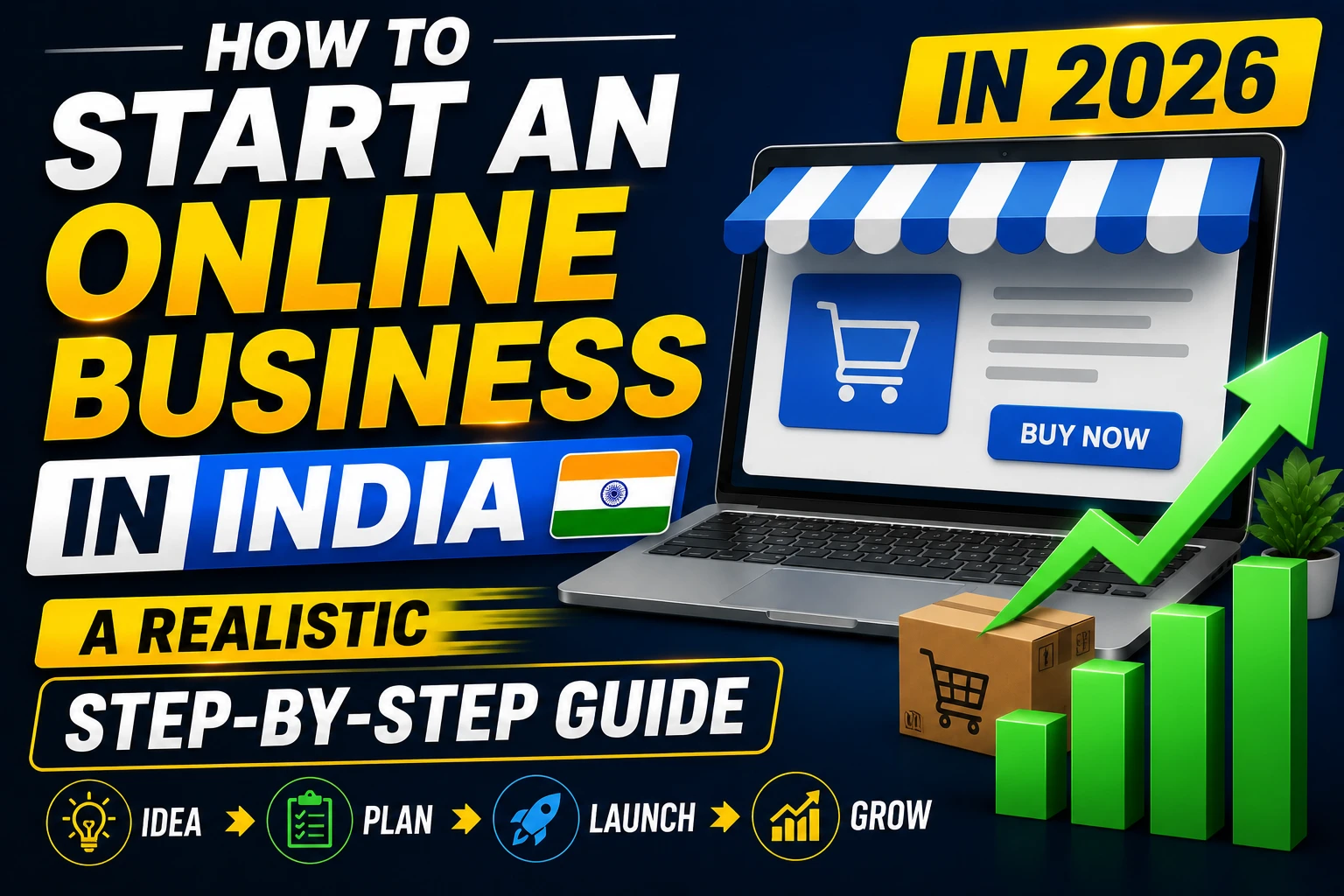
More Indians started online businesses in 2025 than in any previous year. Not because it got easier — it was already accessible. But because the tools, the platforms, and the customer base have all matured to the point where a well-executed idea can become a real business in a matter of weeks rather than months.
If you’re thinking about starting one, this guide is written for you — not the version of you who has a detailed business plan and seed funding, but the version sitting in Aligarh, Agra, Pune, or Patna with a skill or a product idea, wondering where on earth to start.
Here’s the honest, complete picture.
“Online business” covers an enormous range. Before you pick a platform or register a company, be clear on your model — because each has different requirements, costs, and paths to profit.
| Business Model | What It Is | Example |
| Product ecommerce | Selling physical goods online | Handmade jewellery, clothing, books, hardware |
| Digital products | Selling downloadable goods | Online courses, templates, ebooks, presets |
| Services | Selling your skills/time | Freelance design, consulting, coaching, writing |
| Agency | Selling a team’s skills/time | Web development, digital marketing, content agency |
| Affiliate | Earning commissions recommending others’ products | Review blogs, comparison sites, influencer accounts |
| SaaS / App | Building software people subscribe to | Tools, dashboards, productivity apps |
For most first-time online business owners in India, the most realistic starting points are services (monetising a skill you already have), product ecommerce (selling something you make or source), or digital products (packaging knowledge into a course or guide).
Pick the model that matches what you already know. The biggest mistake new entrepreneurs make is choosing a business model because it sounds lucrative rather than because they have genuine knowledge or access in that space.
The most expensive lesson in business is building something nobody wants. Before you spend money on a website, stock, or tools — spend two weeks validating.
Validation looks like this:
This two-week step saves more money than any business advice ever will.
This is where most Indian first-time entrepreneurs get paralysed by over-complicating what is genuinely straightforward.
For most early-stage online businesses, you need:
1. Udyam / MSME Registration (Free, Recommended First) Register at udyamregistration.gov.in. This is the government’s MSME registration for small businesses. It’s free, takes 15 minutes, gives you a Udyam certificate, and is required for many government benefits and bank loan applications. Do this first — it doesn’t limit you legally and provides immediate benefits.
2. GST Registration (Required when turnover exceeds ₹20 lakh/year for services, ₹40 lakh for goods) You are NOT required to register for GST immediately when starting. Register when your annual turnover crosses the threshold, or earlier if you want to charge GST to business clients (many B2B clients require a GSTIN on invoices). Register at gst.gov.in.
3. Current Bank Account You need a bank account in your business name (or personal account initially) to receive payments. Most Indian banks offer current accounts for ₹0–₹2,000/month maintenance depending on the bank. HDFC, ICICI, and Kotak have strong online banking and API connectivity with payment gateways.
For a sole proprietorship (the simplest structure): Udyam registration + bank account is sufficient to start legally operating. No company registration needed until you’re ready to formalise.
For a Private Limited Company: Register with MCA21 (Ministry of Corporate Affairs). Costs approximately ₹7,000–₹15,000 with a CA or company secretary, takes 10–20 working days. Best option if you plan to raise investment or have multiple founders. Not necessary for most solo online businesses in the first year.
Before you can sell online, you need a way to receive money digitally from customers.
Best options for Indian online businesses in 2026:
Razorpay — India’s most popular payment gateway. Accepts all UPI apps (GPay, PhonePe, Paytm), debit/credit cards, net banking, and EMI. Setup is free. Transaction fee: 2% per successful payment. Most ecommerce sites and digital product sellers use Razorpay.
UPI + QR Code — For very small businesses just starting, a simple UPI ID (linked to Google Pay or PhonePe) is enough to start receiving payments. No setup, no fees, instant. Upgrade to a proper payment gateway as you scale.
PayU — Good alternative to Razorpay, slightly more competitive rates for high volumes. Good for subscription-based businesses.
Whichever you choose, set up your payment system before you launch your website — customers who land on your site and can’t find a way to pay you are customers lost forever.
An online business needs at minimum three things to function: a way for people to find you (discovery), a place to learn about you and buy (your website), and a way to contact or purchase from you (payment + contact).
The Minimum Viable Online Presence for an Indian business in 2026:
Your own website — Even a 5-page WordPress site gives you a professional home base that you own and control. It’s findable on Google, sharable in WhatsApp, and credible in a way that a social media profile alone is not. Costs ₹12,000–₹25,000 built professionally, or ₹8,000–₹12,000 DIY. See our complete guide to building a business website in India.
Google Business Profile (free) — If you have a physical location or serve customers in a specific city, set this up immediately at business.google.com. It gets you on Google Maps and makes you discoverable for local searches.
One primary social media channel — Instagram for consumer businesses. LinkedIn for B2B. Pick one, not five.
WhatsApp Business (free) — Essential for Indian businesses. Your customers want to reach you here.
A Shopify store is necessary if you’re selling products online directly. A WordPress website works for service businesses, professional services, and content sites.
This is where most new online businesses struggle — not building the product or website, but finding the first paying customers.
The fastest path to first customers for an Indian online business:
Your existing network first. Tell everyone you know about your new business. Post on your personal WhatsApp status. Tell your neighbourhood, your friends, your former colleagues. Your first 5–10 customers almost always come from people who already know you. This feels uncomfortable but it works.
Join and help in relevant online communities. Facebook Groups for your industry or city. LinkedIn groups. Quora questions in your niche. Be genuinely helpful — answer questions, share knowledge, don’t just advertise. Trust builds organically.
Get your first testimonial as a priority. Offer your first 2–3 customers a significant discount in exchange for an honest testimonial (with their name and photo). Social proof is more valuable than the revenue from full-price early sales.
Start with a narrow focus. Don’t try to serve everyone in India from day one. “I design logos for Aligarh businesses” is easier to market than “I’m a graphic designer.” Narrow positioning leads to faster early customer acquisition.
You will eventually hire people or agencies to handle marketing. But if you don’t understand the basics yourself, you’ll be unable to evaluate whether the work being done for you is good or not.
The three things every online business founder in India should understand:
1. How SEO works — How people find businesses on Google, what makes a website rank, and what it takes to appear for searches relevant to your business. You don’t need to be an expert, but you need to understand the basics. Our SEO guide for UP businesses is written for exactly this purpose.
2. How social media actually drives business — The difference between vanity metrics (likes, followers) and business metrics (enquiries, sales, website clicks). Understanding this helps you direct any social media effort — yours or an agency’s — toward results that matter.
3. How to read your website analytics — Google Analytics 4 tells you where your visitors come from, what they read, and whether they contacted you. Being able to read this data means every decision about your digital marketing is based on evidence rather than guessing.
Most online businesses that fail in India don’t fail because the idea was bad. They fail because the founder stops too early, exhausts their budget before getting traction, or makes expensive mistakes that were avoidable.
Here’s what to prioritise in your first 12 months:
Money:
Customers:
Digital presence:
Legal and financial:
We’re a web development and digital marketing agency from Aligarh, India — and building the digital foundations for new and growing Indian businesses is exactly what we do.
Whether you need a professional WordPress website, a Shopify online store, SEO to get found on Google, or social media management — we can build the digital side of your online business while you focus on the product and the customers.
Talk to us about your new business →
How much money do I need to start an online business in India? The minimum viable budget varies by business type. A service business (freelancing, consulting) can start with almost zero capital — a phone, a WhatsApp Business account, and a basic website (₹8,000–₹15,000). A product ecommerce business needs initial inventory plus a website (₹30,000–₹80,000 to launch properly). A digital products business (online course, ebook) needs content creation time but minimal financial investment.
Do I need to register a company to start an online business in India? No. You can legally start as a sole proprietor with just an Udyam MSME registration and a bank account. GST registration is required only when turnover exceeds ₹20 lakh (services) or ₹40 lakh (goods). A Private Limited Company registration is advisable once you have consistent revenue and plan to scale or take investment.
How do I receive online payments for my Indian business? The most common payment solutions for Indian online businesses are Razorpay and PayU, which accept UPI, debit/credit cards, and net banking. For very early-stage businesses, a simple UPI ID (Google Pay, PhonePe) is sufficient. Integrate Razorpay into your website once you’re ready to process regular transactions.
Which is the best platform to sell products online in India — own website or Amazon/Flipkart? Both serve different purposes. Amazon/Flipkart marketplaces give you immediate traffic but low margins, no customer ownership, and fierce competition. Your own website (via Shopify) gives you full margins, customer data, and brand control but requires you to drive your own traffic. The best strategy for most Indian product businesses is both: start on marketplaces to validate demand, build your own website for brand and margin.
How long does it take for an online business in India to start making money? Realistic timelines vary enormously by business type and effort. Service businesses can earn first revenue within 2–4 weeks if they actively seek customers. Product businesses typically take 2–6 months to reach consistent revenue. Most online businesses in India take 12–18 months to reach stable monthly income. The businesses that succeed are almost always the ones that persist through the first 12 months without giving up after early setbacks.

If you’re looking for a reliable Web Developer in Aligarh, look no further than Techno Alig. Contact us today to discuss your project and take the first step towards establishing a powerful online presence.




No spam, notifications only about new offers, services.
chat_bubble_outline Leave a Reply