Loading Article Title...
🍪 We use cookies to make sure you get the sweetest experience on our website — smooth, secure, and perfectly tailored just for you! 💫✨
Web Architect & Digital Strategist at Techno Alig. Passionate about building high-performance websites, e-commerce platforms, and data-driven SEO strategies for growing businesses.
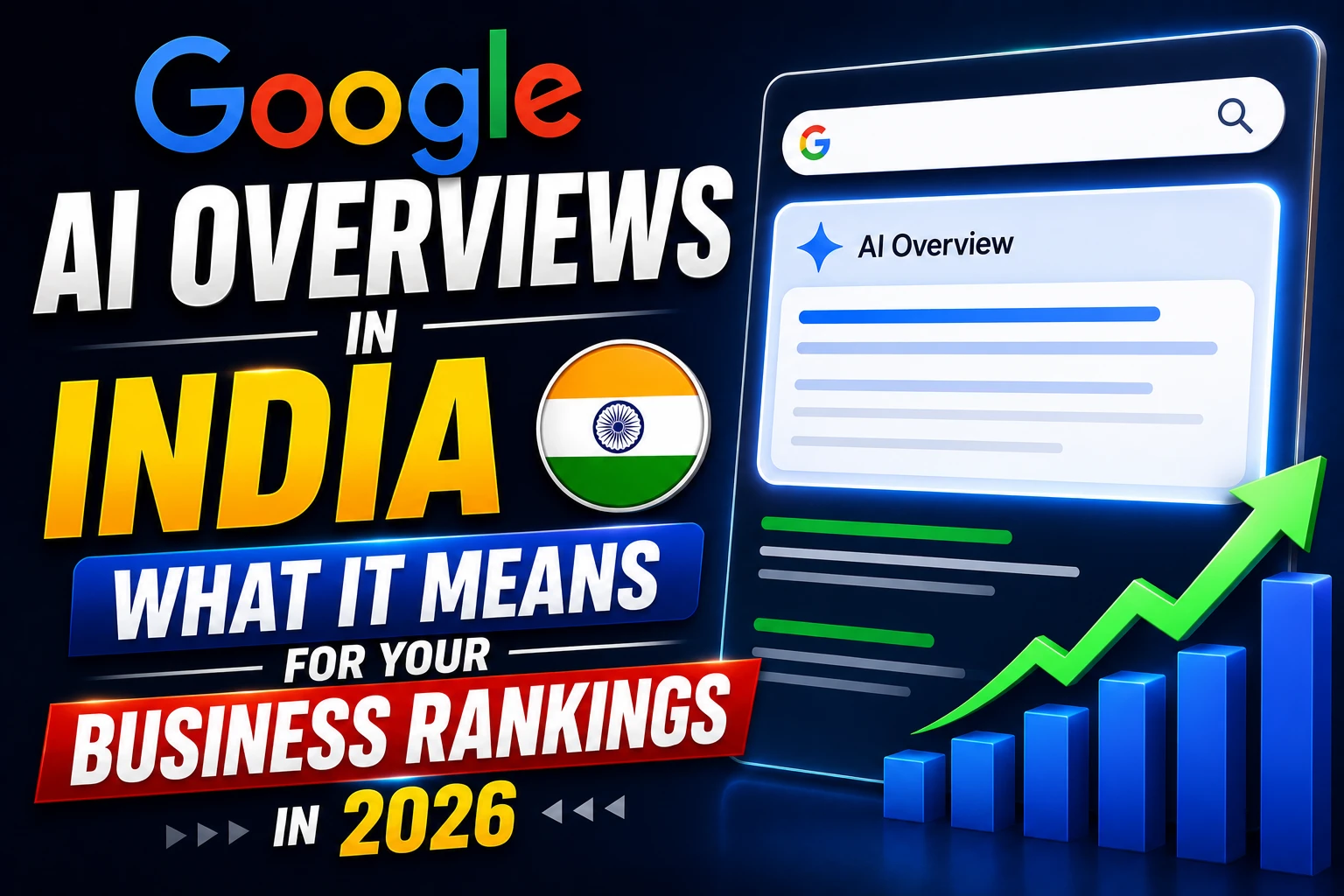
If you’ve searched for something on Google India recently, you’ve probably noticed a new box that appears before the normal blue links — a short AI-generated paragraph that answers your question directly, with a few cited sources below it.
That’s Google AI Overview (previously called Search Generative Experience or SGE). It now appears on roughly 47% of informational searches in India, and it’s changing how people interact with search results in a way that hasn’t been seen since Google first introduced Featured Snippets.
If you run a business with a website, you need to understand what this means. Not to panic — but to adapt.
Google AI Overview is an AI-generated summary that appears at the very top of Google search results for many queries. It’s powered by Google’s Gemini AI model, which reads and synthesises information from multiple websites to produce a direct answer.
When someone searches “best practices for managing a WordPress website,” Google AI Overview shows a 150–300 word summary with 3–5 source citations instead of (or above) the traditional ten blue links. The user gets their answer without necessarily clicking any link.
This is the fundamental shift: Google is now summarising the internet for users instead of just pointing them to it.
The impact is real but nuanced. Here’s what the data actually shows:
Informational queries are most affected. Questions like “how to”, “what is”, “explain”, “difference between” — these are the searches where AI Overviews appear most. If your website traffic comes primarily from informational blog posts, you may have seen a 15–30% traffic drop from those specific pages in 2026.
Commercial and local queries are largely unchanged. Searches like “web developer Aligarh”, “best restaurant near me”, “buy WordPress theme India” — Google still shows traditional search results for these because users want to find a specific business, not a summary. Your service pages are not at risk the same way your blog posts are.
Being cited in AI Overviews is a new traffic source. When Google’s AI cites your website in an AI Overview, it places a small linked icon next to your source. Websites that are cited in AI Overviews report referral traffic from those citations — a new type of visibility that didn’t exist 18 months ago.
The net result for most Indian business websites: mixed. Blog traffic may dip slightly. Service page traffic and local search traffic are mostly stable. But websites that optimise for AI citation can capture a new source of authoritative visibility.
Here’s something many Indian business owners don’t fully appreciate yet: when Google AI cites your website as a source in an AI Overview, your website is being positioned as an authority on that topic to millions of users — even if they never click through.
This is called brand impression volume — and it builds trust faster than a traditional ranking position can. A user who sees “According to Techno Alig…” in a Google AI answer is having that brand name planted in their memory without actively searching for you.
Over time, businesses that appear regularly in AI Overviews for their topic area will see measurable increases in branded searches (people searching for them specifically) and direct traffic. This is a longer-term benefit, but it’s real.
Based on analysis of thousands of AI Overview citations across Indian search queries, here’s what earns citations:
Content that directly answers a specific question. AI Overviews are built to answer queries. If your content has a clear question as a heading and a clear, complete answer immediately below it — you’re a candidate for citation. Vague, general content is almost never cited.
Content with specific, verifiable data. “India’s digital ad spend crossed ₹78,000 crore in 2025” is citable. “Digital marketing is growing fast in India” is not. Specific numbers, dates, and named sources are what AI systems extract and attribute.
Well-structured, clean HTML. Google’s AI crawler cannot execute JavaScript well. Content that lives in JavaScript-rendered components may be invisible to the AI. Server-side rendered content in clean HTML is far more likely to be indexed and cited.
Content from websites with topical authority. A web development agency with 15 detailed, coherent articles about web development is more likely to be cited on web development topics than a general lifestyle blog with one post on the subject. Consistent, topic-focused publishing builds the topical authority that earns AI citations.
Content from websites Google already trusts. AI Overviews draw primarily from websites already ranking in the top 10 for that query. The fastest path to AI citation is still traditional SEO — ranking well for your key terms remains the gateway.
When you write a blog post section about a topic, the first sentence after the heading should be the direct answer — not a warm-up. “The cost of SEO in India ranges from ₹5,000 to ₹1,00,000 per month depending on scope” is a direct answer. “Great question, there are many factors that influence SEO pricing…” is not.
AI systems look for the most direct, confident answer to extract. Give it to them in the first two sentences.
Instead of “SEO Pricing India,” write “How Much Does SEO Cost in India?” This matches how users type queries and how AI systems interpret what a section is answering.
FAQ sections are AI citation gold. Each Q&A is self-contained, clearly structured, and answering a specific question — exactly the format AI Overview systems extract. Our SEO guide for UP businesses and every article we’ve recently published includes a strong FAQ section for exactly this reason.
Don’t write “many businesses are using social media.” Write “Over 490 million Indians use Instagram monthly (Source: Meta, 2026).” Specific, attributed statistics are extracted by AI at much higher rates than general claims.
Check your robots.txt file and ensure you’re not accidentally blocking Googlebot or other AI crawlers. WordPress sites using security plugins sometimes inadvertently block crawler access to content. Check Google Search Console’s “Coverage” report for crawl errors.
One article on a topic will not earn consistent AI citation. Ten coherent, interlinked articles that together cover every aspect of a topic signal topical authority to Google. This is what our content strategy for Techno Alig is building — a topic cluster around web development, SEO, social media, and digital marketing that establishes us as an authoritative Indian source.
No. And here’s why.
Google’s fundamental goal has never changed: serve the most relevant, trustworthy answer to a user’s query. AI Overviews are a new delivery mechanism for that, not a new set of rules.
Websites that were ranking well because they produced genuinely useful, accurate, well-structured content are still doing well — often better, because they’re now being cited in AI Overviews in addition to ranking in blue links.
Websites that were ranking because of bulk content production, weak link schemes, or keyword stuffing have taken harder hits. AI Overviews have accelerated the already-happening trend toward quality over quantity.
The practical response is the same as it’s always been: produce content that genuinely answers your audience’s questions better than anyone else. Everything else — traditional rankings, AI citation, featured snippets — follows from that.
At Techno Alig, we’ve been building AI-ready content structures into all our client work since 2025. Every article we write follows the same structural principles — direct opening answers, question-based headings, specific data, self-contained FAQ sections — that maximise both traditional Google rankings and AI Overview citation probability.
Want to know how your website is currently performing against AI Overviews? We include an AI citation readiness check in our free SEO audit.
What is Google AI Overview? Google AI Overview is an AI-generated summary box that appears at the top of Google search results for many informational queries. Powered by Google’s Gemini AI, it synthesises information from multiple websites to provide a direct answer with cited sources. It appears on approximately 47% of informational searches in India as of 2026.
Does Google AI Overview hurt website traffic? It can reduce traffic to informational blog posts, as some users get their answer from the AI summary without clicking through. However, commercial queries, local searches, and transactional searches are largely unaffected. Websites cited as sources in AI Overviews gain a new form of brand visibility.
How do I get my website featured in Google AI Overviews? To appear in Google AI Overviews: write content that directly answers specific questions, use question-based headings, include specific data with source attribution, create comprehensive FAQ sections, build topical authority through multiple interlinked articles, and ensure your website is accessible to Googlebot (no accidental crawl blocks).
Will Google AI Overviews replace traditional search results? No. Google AI Overviews coexist with traditional blue link results. For local searches, commercial queries, and navigational searches, traditional results remain dominant. AI Overviews primarily appear for informational queries. Both types of SEO continue to matter.How is Google AI Overview different from Featured Snippets? Featured Snippets extract a passage directly from one website. Google AI Overviews synthesise information from multiple websites to create a new summary. AI Overviews also show multiple source citations rather than one, and appear more frequently than Featured Snippets did.

If you’re looking for a reliable Web Developer in Aligarh, look no further than Techno Alig. Contact us today to discuss your project and take the first step towards establishing a powerful online presence.

No spam, notifications only about new offers, services.
chat_bubble_outline Leave a Reply