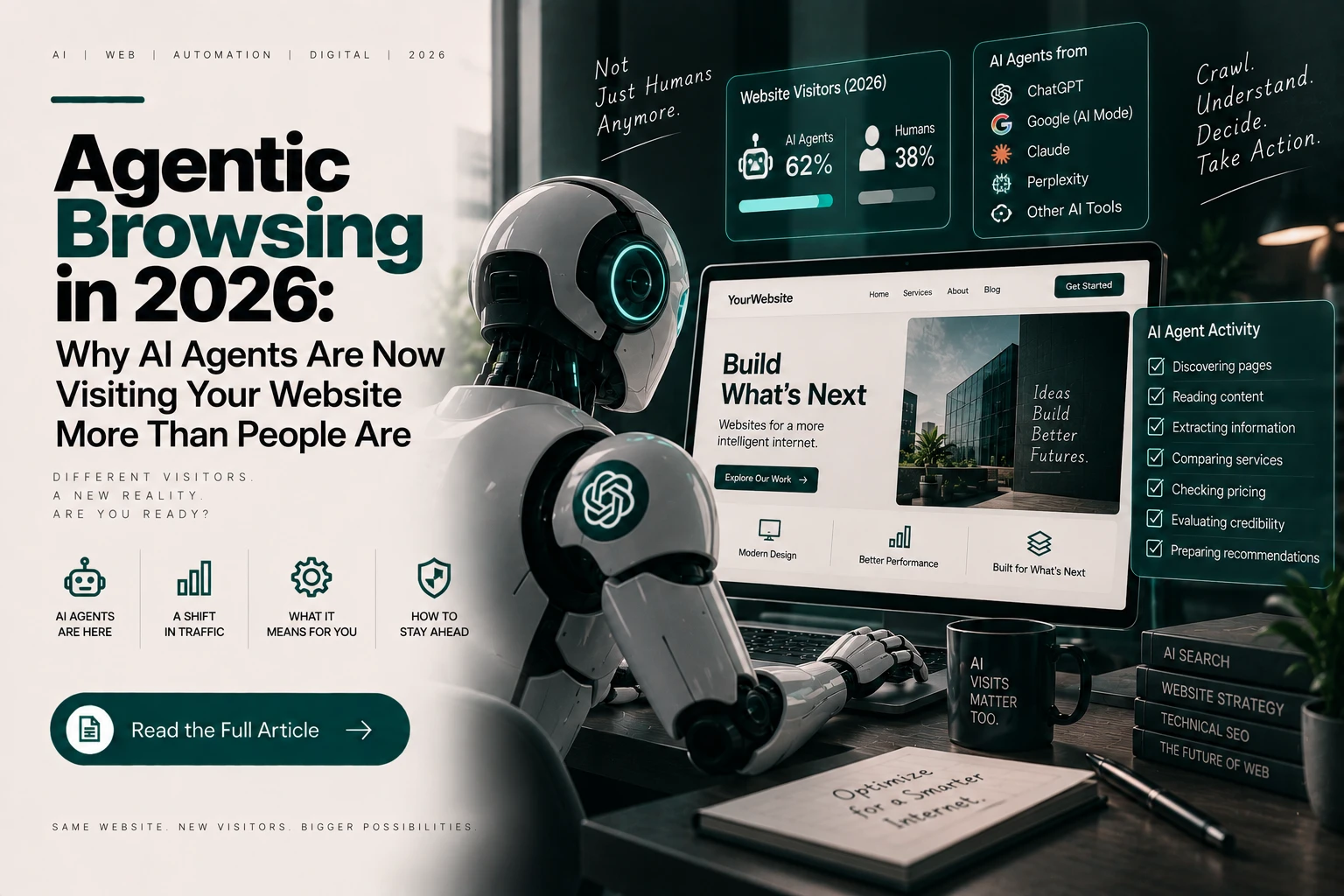
In June 2026, Cloudflare’s chief executive Matthew Prince reported that automated traffic had passed human traffic for the first time — 57.3% of requests to web pages came from machines against 42.7% from people, a crossover he had previously projected wouldn’t arrive until 2027. For anyone running a business website, that single statistic reframes a question most site owners have never had to ask: what happens when the visitor isn’t a person at all?
What Is Agentic Browsing?
Agentic browsing is when an AI agent navigates a website on a user’s behalf — reading pages, clicking links, filling forms, comparing options, and sometimes completing a transaction. It differs from traditional crawling because agents make decisions rather than just indexing content.
The distinction matters enormously in practice. A traditional search crawler reads your page and files it away for later retrieval. An agent evaluates your business against a user’s stated requirements, compares you to alternatives it found elsewhere, and either selects you or moves on — all before a human sees anything. Agentic browsers also arrive with cookies, session patterns, and user-agent strings that closely resemble human browsing, which is why many businesses don’t realise how much of this traffic they’re already receiving.
How Much Agentic Traffic Is There Actually?
Agentic traffic is growing faster than almost any other web trend measured in 2026. HUMAN Security’s 2026 benchmark report found AI agent and agentic-browser traffic up 7,851% year over year.
The concentration is heavily skewed by industry. HUMAN’s April 2026 data shows three sectors capturing 98% of all agentic traffic: media at 45.62%, ecommerce at 38.20%, and travel at 14.12%. Browser-based agents specifically account for roughly 71% of all observed agentic activity. Notably, only about 3.16% of that agentic activity currently reaches checkout or payment routes — a gap that tells you agents are researching and evaluating far more than they’re transacting, at least for now.
Meanwhile, AI traffic to US retail sites jumped 393% year over year in Q1 2026, and that traffic reportedly converts at a higher rate than average.
Which AI Agents Are Actually Browsing Websites?
The main agentic browsing surfaces in 2026 are Gemini in Chrome, Perplexity Comet, Microsoft Copilot surfaces, and agentic browsing inside the ChatGPT desktop app.
The landscape has shifted quickly enough to catch people out. OpenAI announced in July 2026 that it was retiring the standalone ChatGPT Atlas browser, with shutdown in August, folding agentic browsing into the ChatGPT desktop app instead. Gemini in Chrome puts an agent directly inside the world’s most-used browser, which makes it the most consequential surface by reach.
The useful insight here is that you don’t optimise for each agent separately. They largely read pages using the same underlying mechanics — parsing rendered HTML, following semantic structure, interpreting forms and links — so improving the site’s underlying legibility serves all of them simultaneously.
How Do AI Agents Actually Read a Web Page?
AI agents read the underlying HTML and semantic structure of a page, not its visual design. They prefer clear headings, semantic landmarks, structured data, and plain text over content locked inside images, complex JavaScript, or purely visual layouts.
This creates a practical gap that catches a lot of well-designed sites out. A page can look excellent to a human and be nearly unreadable to an agent — for example, if critical information (pricing, service descriptions, contact details) only exists inside an image, loads via JavaScript after initial render, or is buried in a layout with no semantic heading structure.
A quick diagnostic anyone can run: view the source HTML of your most important pages and check whether the information a customer actually needs is present in the raw markup. If it isn’t there, an agent may not find it either.
What Is “Agent Readiness”?
Agent readiness is the practice of structuring a website so autonomous AI agents can discover, understand, and interact with it predictably — while the site owner keeps control over content licensing, data exposure, and security.
It breaks down into a few distinct layers:
Discovery — can an agent find what your site offers? Signals include /llms.txt, sitemap.xml, an agent-aware robots.txt, and HTTP link headers pointing to service descriptions.
Understanding — can an agent interpret your content correctly? This depends on semantic HTML, structured data (JSON-LD), clear heading hierarchy, canonical URLs, and alt text coverage.
Interaction — can an agent complete a task on your site? This is where forms, booking flows, and checkout matter, and where emerging standards like WebMCP come in.
Current scores across the web are genuinely poor. One tracker measuring the top 100 websites by traffic found an average agent-readiness score of 55% as of May 2026, with zero A grades among them and 65% still missing an llms.txt file entirely.
Does Agent Readiness Affect Google Rankings?
Agent readiness is not a conventional Google ranking factor. Its impact is on agent-driven referrals — LLM citations, agentic evaluation, and agent-completed actions — rather than on traditional organic position.
That said, the overlap is significant. Several signals that improve agent readiness — sitemaps, structured data, semantic markup, fast and stable page rendering — are the same technical SEO fundamentals that already support conventional rankings. Chrome shipped Lighthouse 13.3 in May 2026 with a dedicated Agentic Browsing audit category, covering llms.txt handling, WebMCP integration, agent accessibility, and layout stability, which signals how seriously browser vendors are treating this.
Where Should a Business Actually Start?
Start with discovery and understanding before interaction. For most businesses in 2026, publishing an llms.txt file, fixing semantic HTML and structured data, and confirming AI crawlers aren’t blocked delivers most of the available benefit at minimal cost.
A practical sequence:
- Audit
robots.txt — confirm you aren’t accidentally blocking legitimate AI agents. Google added a Google-Agent user agent to its official documentation on 20 March 2026, alongside existing agents like GPTBot, OAI-SearchBot, PerplexityBot and ClaudeBot.
- Publish an
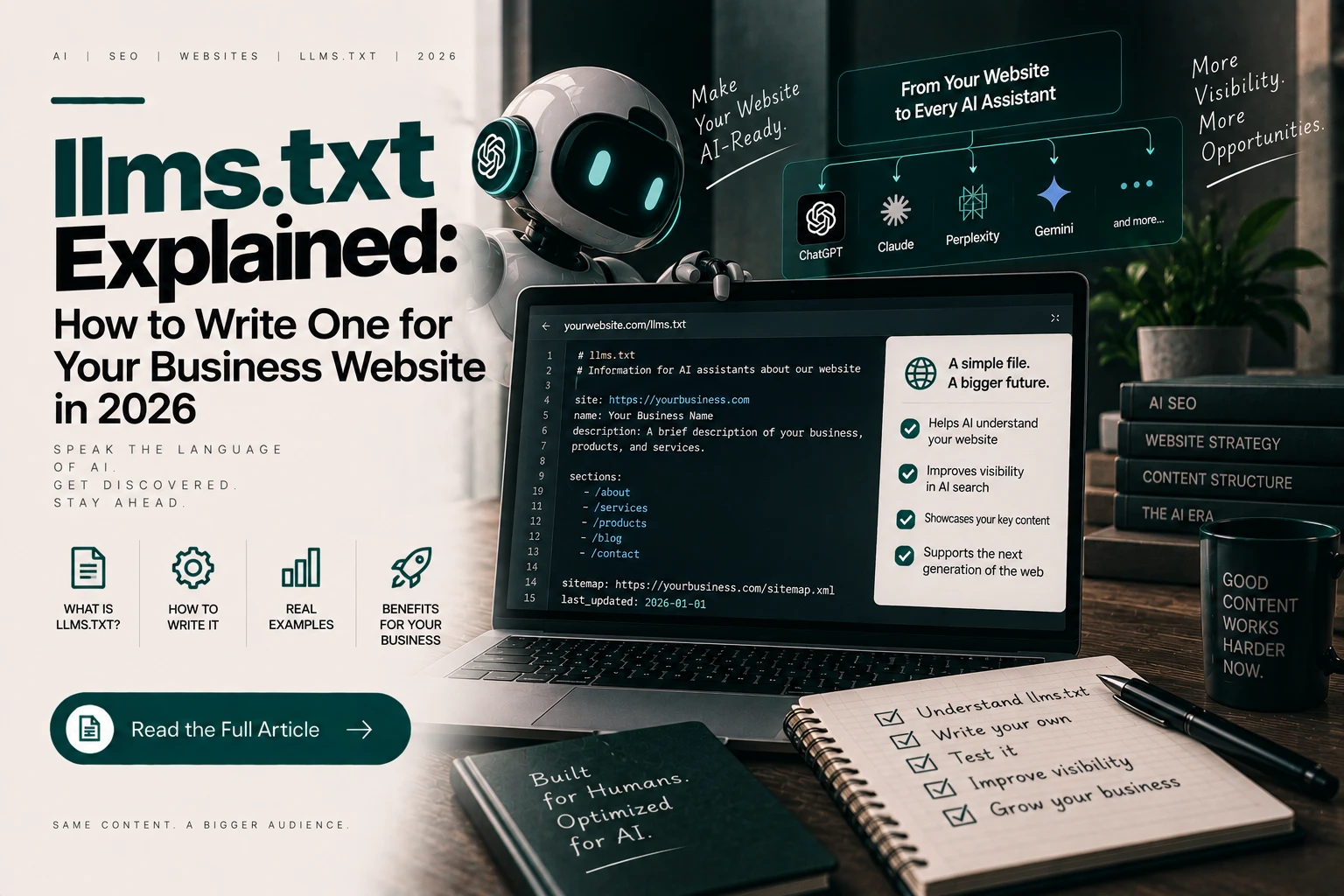
llms.txt file — a curated, Markdown-formatted index of your most important pages with one-line summaries. It takes roughly ten minutes to write well.
- Check your source HTML on critical pages — is the important information actually in the markup?
- Run the Lighthouse Agentic Browsing audit in Chrome DevTools and address what it flags, particularly layout stability issues.
- Fix semantic structure — one clear H1 per page, proper heading hierarchy, semantic landmarks, complete alt text, valid JSON-LD.
- Only then consider interaction standards like WebMCP, which matter most for businesses with booking, quoting, or purchasing flows.
Is This Worth Doing Now, or Is It Too Early?
For most businesses, the discovery and understanding layers are worth doing now because they’re cheap, low-risk, and overlap with existing SEO work. The interaction layer is worth understanding now but implementing selectively, since the standards are still stabilising.
The honest framing is that this is early infrastructure work, not an emergency. But the cost asymmetry favours acting: publishing an llms.txt file and fixing semantic markup costs very little and does no harm even if agentic traffic plateaus, whereas being structurally invisible to agents becomes progressively more expensive to fix once competitors have already done it.
FAQs
Is agentic browsing the same as AI search optimization (GEO)? No. GEO focuses on getting your content cited in AI-generated answers. Agentic browsing optimization focuses on agents actually visiting and using your website, including completing tasks on it. They’re related layers, not the same discipline.
Will AI agents replace human website visitors entirely? No. Agents act on behalf of humans, and most agentic activity currently involves research and evaluation rather than final decisions. The agentic web is a parallel surface layered on top of the human web, not a replacement for it.
Can I block AI agents from my website? Yes, through robots.txt directives and server-level controls. Whether you should depends on your business — media sites protecting content have different incentives than service businesses that want to be discovered and recommended by agents.
How do I know if AI agents are visiting my site already? Check your server logs and analytics for known AI user agents such as GPTBot, ClaudeBot, PerplexityBot, and Google-Agent. Microsoft’s Bing Webmaster Tools also added AI Performance reporting in February 2026, showing impressions and clicks from Copilot and Bing AI answers.
The web is quietly acquiring a second audience, and most sites were built entirely for the first one. The businesses that treat agent legibility as an extension of good technical SEO — rather than an exotic new discipline — are the ones that will be findable when an agent is doing the looking.






chat_bubble_outline Leave a Reply