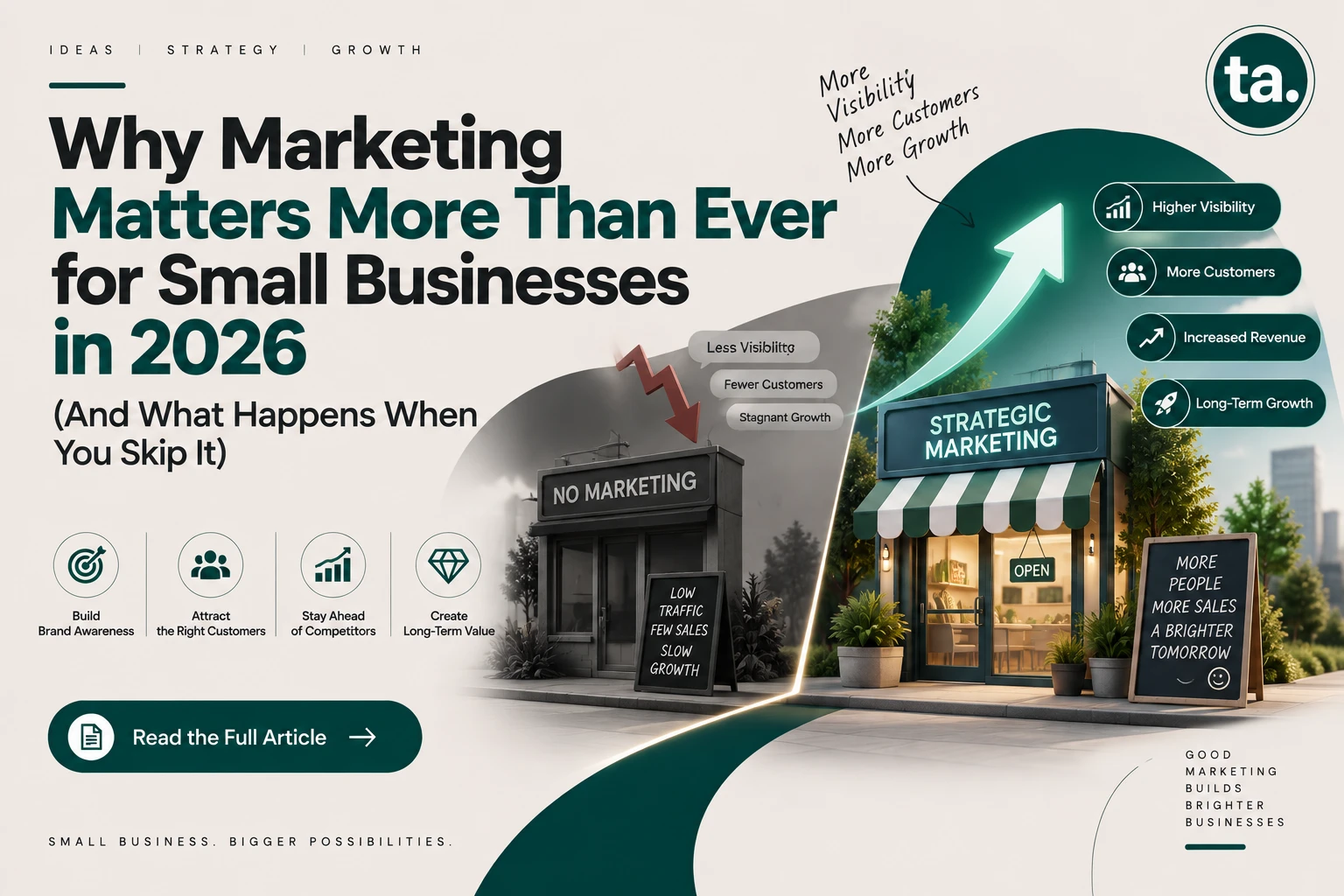
“Our product sells itself” is one of the more expensive assumptions a small business owner can make. It’s rarely true even for genuinely excellent products, and it’s become considerably less true as the number of options available to any given customer has kept growing every year. Here’s a grounded, honest look at why marketing isn’t optional in 2026 — and what actually happens to businesses that treat it as such.
The Core Problem Marketing Solves
A great product or service that nobody knows about generates zero revenue. This sounds obvious stated plainly, but it’s exactly the trap many small businesses fall into — pouring resources into the product or service itself while treating marketing as an afterthought, something to figure out “once things pick up.” The uncomfortable reality is that things rarely pick up on their own; visibility and trust have to be actively built, not assumed.
Over half of small businesses now report relying on digital marketing specifically to connect with customers — not as a supplementary tactic, but as a primary channel for being found at all. That share has only grown as more customer discovery and research has moved online across virtually every industry and region.
What Actually Happens When a Business Skips Marketing
This isn’t abstract — the pattern is consistent and predictable:
You become invisible to people who are already looking for exactly what you offer. Search behaviour data consistently shows the overwhelming majority of purchase decisions now start with some form of online research. A business with no meaningful online presence simply doesn’t exist in that research process, regardless of quality.
You lose customers to competitors with weaker offerings but stronger visibility. This is genuinely frustrating for business owners who know their product or service is better, but it’s a consistent pattern — a mediocre business that’s easy to find and trust regularly outperforms a superior one that’s hard to discover.
You end up entirely dependent on referrals and repeat business, which caps growth at a predictable ceiling. Referral-driven growth is valuable, but it’s inherently limited by the size of your existing network — it can sustain a business, but it rarely scales one.
You lose pricing power. Businesses with strong visibility and trust signals (reviews, content, brand presence) can generally command better prices than those competing purely on being the cheapest option a customer happens to stumble across.
Why 2026 Specifically Raises the Stakes
A few forces have converged to make marketing’s absence more costly than it used to be:
Digital-first discovery has become close to universal. A large majority of both younger and older consumer segments now rely on some form of online search or research before engaging with a business, across nearly every category — from professional services to retail to local businesses.
Review culture has matured into a genuine trust economy. The vast majority of people read reviews before making a purchase decision, and businesses that actively manage their online reputation see meaningfully higher customer spending. A business with no reviews, or unaddressed negative ones, is quietly losing customers who never even reach out to explain why.
Competition for attention has intensified, not eased. More businesses are investing seriously in digital marketing than ever before, which means the relative cost of having no strategy at all — while competitors actively build visibility — compounds over time rather than staying flat.
Marketing Isn’t Just Advertising — That’s the Common Misunderstanding
A lot of small business owners equate “marketing” narrowly with “running ads,” and then conclude marketing isn’t worth it after one underwhelming ad campaign. Marketing is considerably broader than that: it includes how clearly your website communicates what you do, how you show up in search results, how you handle reviews and reputation, the content you publish that answers real customer questions, and the overall experience a prospective customer has before they ever speak to you directly.
Advertising is one lever within marketing — often an important one — but treating it as the entirety of “marketing” is how businesses end up dismissing the whole discipline based on one narrow, poorly executed tactic.
Marketing Compounds — Which Is Exactly Why Delaying It Is Costly
This is the part that’s easy to underestimate: a lot of marketing effort — search visibility, content, reputation, an engaged email list — builds on itself over time rather than resetting with each new period. A business that starts investing seriously in this now will, a year from now, be operating from meaningfully stronger foundations than one that keeps postponing it “until things are more stable.” The businesses that wait usually end up needing marketing more urgently, with less runway and more competitive ground already lost.
A Realistic Starting Point for a Business That’s Never Prioritized Marketing
You don’t need to do everything at once. A sensible starting sequence:
- Make sure your website actually and clearly communicates what you do — this is the foundation everything else points back to.
- Claim and properly fill out your Google Business Profile if you serve local customers — one of the highest-leverage, lowest-cost steps available.
- Start actively collecting and responding to reviews as a routine part of your customer process, not an occasional afterthought.
- Publish content that genuinely answers questions your customers actually ask — this builds search visibility gradually and compounds over time.
- Test one paid channel with a small, defined budget once the foundation above is solid, so the traffic it generates actually converts.
FAQs
Is marketing worth it for a very small business with a tight budget? Yes, though the starting point should be low-cost, high-leverage steps (Google Business Profile, reviews, a clear website) before investing significantly in paid advertising.
How long does it take to see results from marketing investment? It varies by channel — paid advertising can show results within weeks, while SEO and content-driven visibility typically take a few months to build meaningfully, but tend to compound and last longer once established.
Can a business survive purely on word-of-mouth without marketing? Some do, but growth is typically capped by the size of the existing network, and the business remains vulnerable if referral sources change or slow down — marketing generally reduces that dependency and vulnerability.
Marketing isn’t a cost you incur when business is going well — it’s the mechanism that makes business go well in the first place, especially in a market where customers are actively researching before they ever pick up the phone. If you’d like an honest assessment of where to start based on your specific business, get in touch with our team, or explore our digital marketing strategy guide and local SEO guide for small businesses.
Related reading: Our SEO services



chat_bubble_outline Leave a Reply