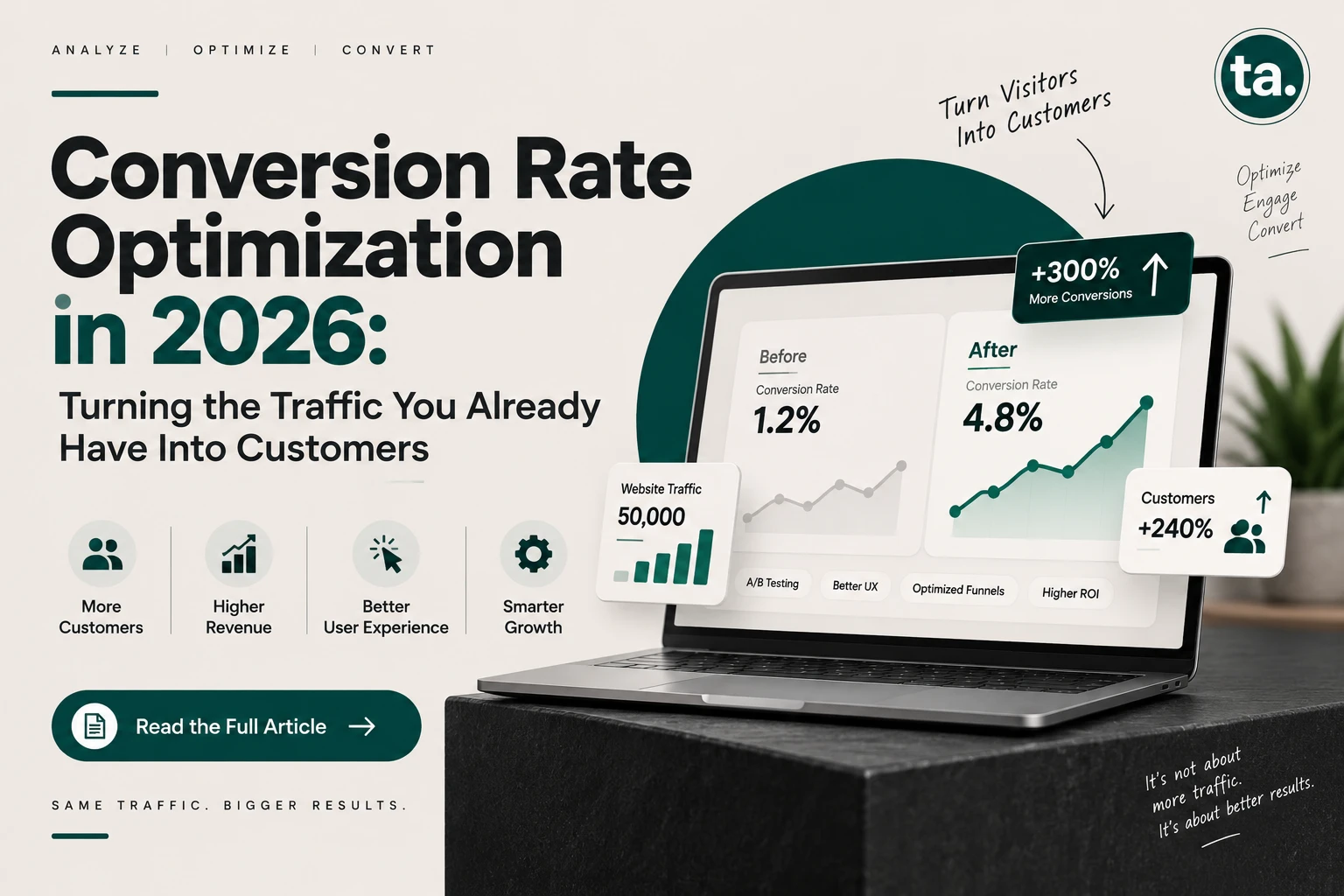
There’s a common instinct when website results are disappointing: get more traffic. More ads, more SEO, more social posts. But for a lot of businesses, the real leak isn’t traffic volume at all — it’s what happens to the visitors already arriving. If 1,000 people visit your site and only 5 take action, doubling traffic to 2,000 visitors, without fixing the underlying problem, just gets you 10 — not the meaningful growth it looks like on paper. This is exactly the gap conversion rate optimization (CRO) is built to close.
What Conversion Rate Optimization Actually Means
CRO is the practice of improving the percentage of website visitors who take a desired action — filling out a form, making a purchase, booking a call — without necessarily increasing traffic at all. It’s often the highest-leverage, lowest-cost improvement available to a business, because you’re extracting more value from spend and effort you’ve already committed to, rather than paying for entirely new traffic.
A business that improves its conversion rate from 1% to 2% has effectively doubled the value of every marketing dollar already being spent — no additional ad budget required.
Why This Matters More in 2026 Than It Used To
Traffic acquisition has gotten more expensive and more competitive across nearly every channel — paid search costs have climbed steadily, organic search results now share space with AI-generated answers that can reduce click-through even for well-ranking pages, and social platforms increasingly favor paid reach over organic. In this environment, squeezing more value out of existing traffic has become proportionally more valuable than it was when traffic was cheaper and easier to acquire in volume.
Where Conversion Usually Breaks Down (And How to Fix Each)
1. The Value Proposition Isn’t Clear Within Seconds
Visitors decide almost immediately whether a page is relevant to what they need. If it takes real effort to figure out what you offer and why it matters, most visitors leave before making that effort.
Fix: Lead with a clear, specific statement of what you do and for whom — not a clever tagline that requires interpretation.
2. Too Much Friction in the Action Itself
Every additional form field, every extra click required to complete an action, measurably reduces the percentage of people who follow through. Research on checkout and form usability consistently shows abandonment climbing sharply as required fields increase beyond what’s genuinely necessary.
Fix: Ask only for information you actually need at this stage. A name, email, and one qualifying question is usually enough for an initial inquiry — additional detail can be gathered later in the conversation.
3. Trust Signals Are Missing or Buried
Visitors arriving from an unfamiliar business are naturally cautious. Without visible proof — reviews, case studies, recognizable client logos, clear credentials — hesitation wins out over action, even when the offer itself is genuinely strong.
Fix: Place trust signals near your calls to action, not buried on a separate page most visitors never reach.
4. The Call to Action Is Vague or Hard to Find
“Learn more” and “Submit” tell a visitor almost nothing about what happens next. Buttons that blend visually into the page, or that appear only once far down a long page, get missed by visitors who would otherwise have converted.
Fix: Use specific, outcome-focused button text (“Get a Free Quote,” “Book Your Consultation”) and repeat the primary call to action at natural points throughout longer pages, not just once at the very end.
5. Page Speed Is Quietly Killing Conversions Before Content Even Loads
A slow-loading page loses a meaningful share of visitors before they ever see your offer, your trust signals, or your call to action — no amount of on-page optimization matters if the page hasn’t finished loading when a visitor gives up and leaves.
Fix: Treat page speed as a conversion issue, not just a technical or SEO one — the two are deeply connected.
6. Mobile Experience Doesn’t Match Desktop Quality
With mobile now representing the majority of traffic for most businesses, a conversion path that works smoothly on desktop but is awkward, cramped, or broken on mobile is quietly costing more conversions than most businesses realize, simply because it’s less visible during a quick desktop-based review.
Fix: Actually test your own conversion path on a real phone, on a real mobile network — not just a resized browser window on a desktop monitor.
A Practical CRO Process (Not Guesswork)
1. Identify where visitors are actually dropping off. Use analytics to find the specific page or step where the largest share of visitors leave without converting — this tells you where to focus, rather than guessing.
2. Form a specific, testable hypothesis for each fix. “Simplifying the contact form from 8 fields to 4 will increase form completions” is testable. “Make the page better” is not.
3. Change one meaningful thing at a time where possible. Testing multiple changes simultaneously makes it hard to know which change actually drove any improvement you see.
4. Give changes enough time and traffic to produce a reliable signal before drawing conclusions — small sample sizes can be misleading in either direction.
5. Treat CRO as ongoing, not a one-time project. Visitor behaviour, competitive context, and your own offers all shift over time — what converted well a year ago may not convert as well today.
FAQs
What’s a “good” conversion rate? It varies enormously by industry, traffic source, and what counts as a conversion — a meaningful benchmark is your own historical performance, tracked consistently over time, rather than an arbitrary industry average.
Is CRO more important than getting more traffic? Neither is inherently more important — but CRO is often the more cost-effective first step, since it improves the return on traffic you’re already paying for or already earning organically, before scaling spend further.
Do I need special software to do conversion rate optimization? Basic analytics (to identify where visitors drop off) is essential; dedicated A/B testing tools become valuable once you have enough traffic volume to generate statistically reliable results, but aren’t strictly necessary to start improving obvious friction points.
Improving how well your website converts the traffic it already gets is consistently one of the highest-return investments available — often more so than acquiring additional traffic outright. If you’d like a conversion audit of your current website, get in touch with our team, or read our related guides on website development fundamentals and performance marketing.
Related reading: Core Web Vitals and website speed guide





chat_bubble_outline Leave a Reply