Every business owner asking for a website eventually hits this question — and every developer they ask gives a different answer depending on what they happen to sell.
WordPress developers say WordPress. Custom coders say custom. Nobody wants to give you the honest, “it depends on your specific situation” answer because it sounds wishy-washy.
So let’s actually break it down — honestly, practically, and with real numbers.
What We’re Actually Comparing
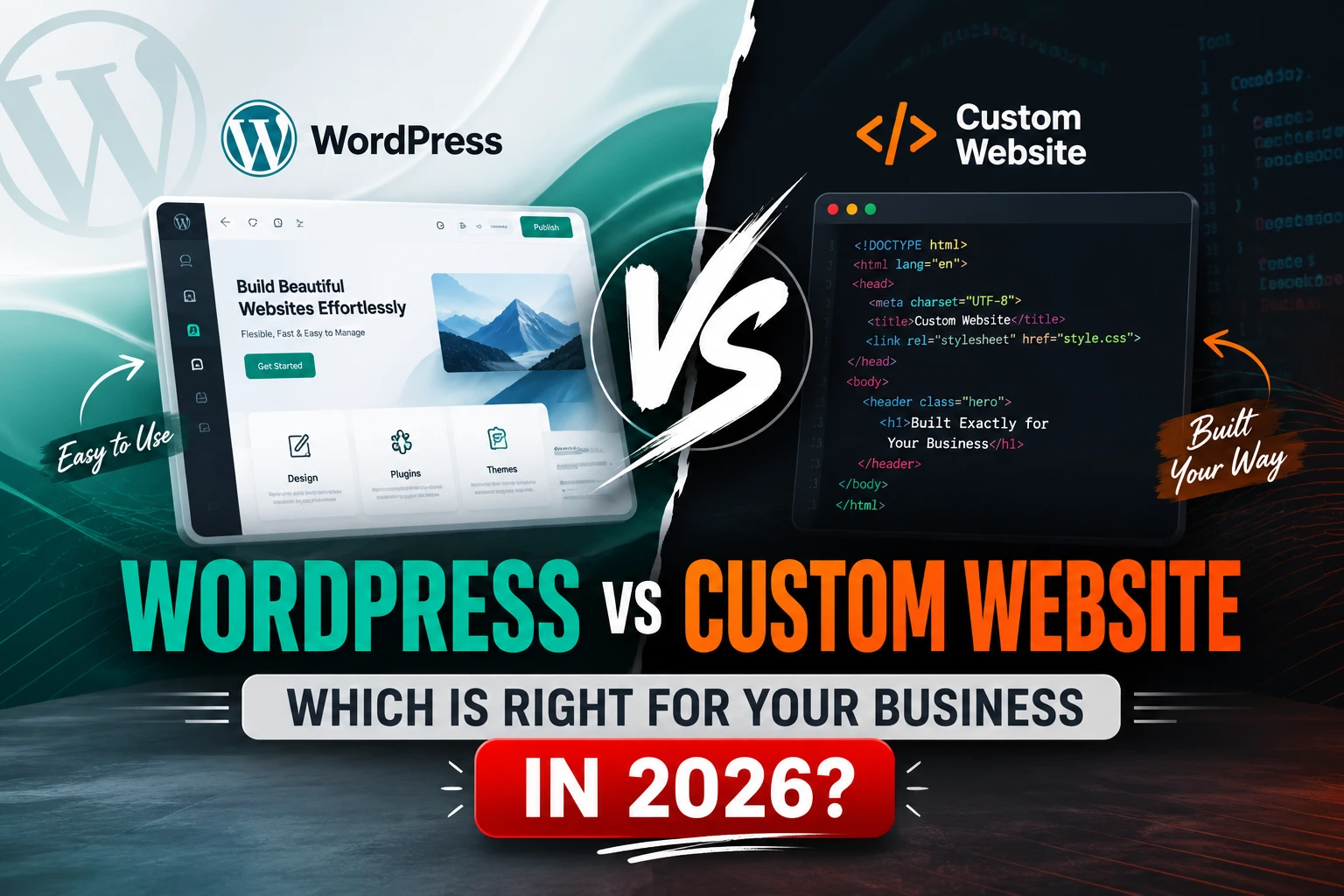
When we say “WordPress website,” we mean a site built on WordPress.org — the open-source CMS that currently powers 43% of all websites on the internet. You get a content management system, thousands of themes, and tens of thousands of plugins that add functionality without writing code.
When we say “custom-coded website,” we mean a site built from scratch using HTML, CSS, JavaScript, and backend languages like PHP, Python, or Node.js — with a framework like React or Next.js for modern applications. There’s no pre-built CMS; the developer builds exactly what you need and nothing else.
Both are legitimate approaches. The right one depends on your situation.
Round 1: Cost
WordPress wins this round easily.
A professional WordPress website in India typically costs:
- Basic business site (5–8 pages): ₹12,000 – ₹25,000
- Mid-range with custom design: ₹25,000 – ₹60,000
- Full-featured with ecommerce (WooCommerce): ₹50,000 – ₹1,20,000
A custom-coded website for the same scope costs 3–5× more — because every feature that WordPress provides for free via plugins has to be built manually. Login systems, contact forms, image galleries, SEO settings, performance caching — a WordPress developer installs a plugin in 10 minutes; a custom developer builds it in 3 days.
Verdict: If budget is a primary concern — and for most Indian small businesses it genuinely should be — WordPress is the more sensible starting point.
Round 2: Speed to Launch
WordPress wins again.
With WordPress, a competent developer can have a professional, functional business website live in 7–14 days. The structure is pre-built; you’re mostly making design decisions and adding your content.
Custom development for an equivalent site takes 4–10 weeks minimum. Every element is built from scratch, tested, debugged, and optimised. That’s good when you need something the market doesn’t offer out of the box. For a 10-page business website, it’s overkill.
Verdict: WordPress is significantly faster to launch. If you need a website this month, custom is not your option.
Round 3: SEO
This one is a tie — with an asterisk.
Here’s what the WordPress critics will tell you: WordPress is bloated. It generates messy HTML. The database queries are slow. A custom site can be leaner and faster.
Here’s what they’re not telling you: with a well-configured WordPress setup — a fast hosting provider, a lightweight theme (like GeneratePress or Astra), a caching plugin, and proper image compression — WordPress sites regularly score 90+ on Google’s Core Web Vitals assessment. The world’s largest news publishers, ecommerce sites, and content platforms run on WordPress.
The reality is that WordPress, set up correctly, is excellent for SEO. Plugins like Yoast SEO and RankMath give you fine-grained control over titles, meta descriptions, schema markup, and XML sitemaps that many custom-coded sites simply don’t have.
The SEO advantage of a custom site only materialises if it’s built by developers who deeply understand performance optimisation — which is rare and expensive.
Verdict: Properly configured WordPress matches or exceeds most custom sites for SEO. The gap only matters at enterprise scale.
Round 4: Flexibility and Customisation
Custom website wins this round.
WordPress has limits. If you need a very specific user flow, a unique database structure, real-time features, a complex booking engine, or anything that doesn’t fit the CMS model — WordPress becomes more of a constraint than a tool. You end up fighting the platform.
Custom development has no such limits. You’re building exactly what you need. The tradeoff is cost and time, but if the functionality is core to your business, it’s worth it.
Examples where custom makes sense:
- SaaS platforms and web applications
- Marketplaces with buyer/seller accounts
- Booking systems with complex logic (availability, pricing tiers, multi-location)
- Internal tools and dashboards for your business
- Anything with real-time data (live tracking, live chat, live prices)
Examples where it’s overkill:
- Business brochure websites
- Restaurant menus and contact pages
- Portfolio sites
- Blogs and content sites
- Basic ecommerce (Shopify or WooCommerce handles this well)
Verdict: Custom wins when the website is the product. WordPress wins when the website supports the product.
Round 5: Long-Term Maintenance
This one depends on who built it — but WordPress has an edge for most businesses.
WordPress maintenance is relatively straightforward. Updates are mostly one-click. Thousands of developers in India understand the platform, so you’re never locked into a single vendor. If your current developer becomes unavailable, any competent WordPress developer can pick up where they left off.
Custom sites are harder. If the developer who built your site is unavailable, the new developer needs to understand the custom codebase before touching anything. That takes time and money. And if the code wasn’t documented well (which is common for small agency projects), it’s essentially a rebuild.
Verdict: WordPress wins on maintainability for most Indian businesses. Custom wins only if the codebase is properly documented and the same developer relationship continues long-term.
The Honest Recommendation
Here’s the actual framework:
| Your Situation | Recommended Choice |
| First business website, under ₹50,000 budget | WordPress |
| Brochure site for services/professional practice | WordPress |
| Ecommerce selling physical products | Shopify or WooCommerce |
| Blog or content site | WordPress |
| Web app / SaaS / portal / marketplace | Custom (React / Next.js) |
| ₹2 lakh+ budget, unique functionality needed | Custom |
| Already have a WordPress site that works | Stick with WordPress |
What We Build at Techno Alig
At Techno Alig, we build both — and we’ll tell you honestly which one is right for your situation before you spend a rupee.
Our WordPress websites start from ₹12,000 and include proper SEO setup, mobile optimisation, Google Analytics, and a CMS you can update yourself. Our custom development projects start with a proper brief and a realistic timeline.
We don’t push customers toward the more expensive option. We help you make the right decision for your budget and goals.
Talk to us about your website project →
Frequently Asked Questions
Is WordPress good for small businesses in India? Yes. WordPress is the most widely used website platform for Indian small businesses for good reason — it’s affordable, flexible, easy to manage after launch, and well-supported by local developers. For most service businesses, restaurants, professionals, and retailers in India, WordPress is the right starting point.
What is the cost of a WordPress website in India in 2026? A professional WordPress website in India costs ₹12,000–₹60,000 depending on design complexity, number of pages, and functionality. Basic sites with standard themes cost less; custom-designed sites with advanced features cost more. Techno Alig’s WordPress sites start from ₹12,000.
Can I update my WordPress website myself? Yes, that’s one of WordPress’s key advantages. Once your developer builds the site, you can update text, images, add blog posts, and manage products yourself through the WordPress dashboard without any technical knowledge.
Is a custom website faster than WordPress? Only if built with performance as a priority and hosted on good infrastructure. A poorly optimised custom site is slower than a well-optimised WordPress site. In practice, a WordPress site with quality hosting, a lightweight theme, and caching scores comparably to most custom sites on Google’s Core Web Vitals.
When should I choose a custom-coded website over WordPress? Choose custom development when you need functionality that doesn’t exist as a WordPress plugin — complex web applications, marketplaces, real-time features, or SaaS products. For standard business websites, custom development is usually unnecessary expense.