There’s a meaningful difference between an AI agent being able to read your website and being able to use it. An agent can summarise your service page perfectly and still fail completely the moment it tries to submit your quote form. WebMCP is the emerging standard aimed squarely at that gap.
What Is WebMCP?
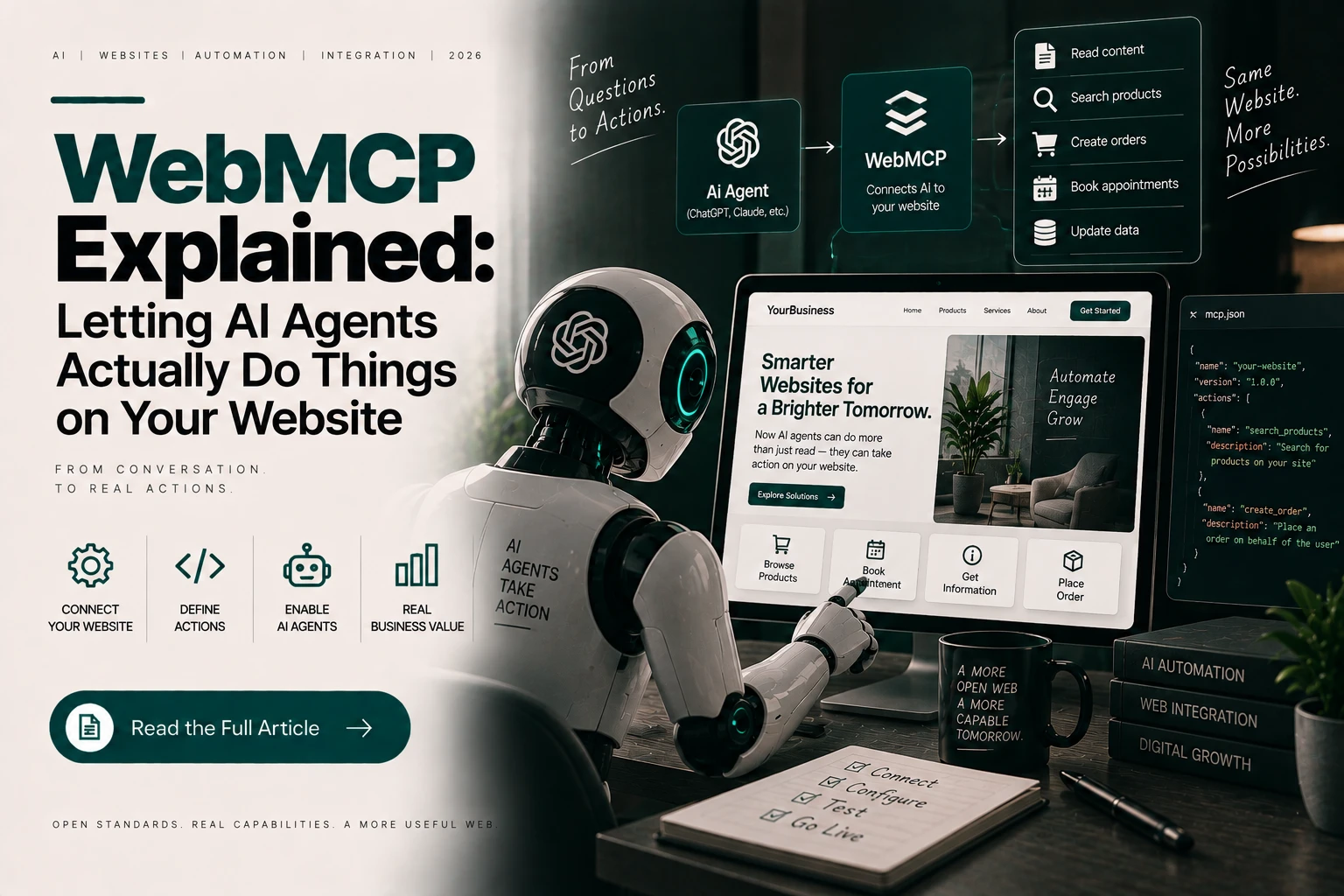
WebMCP (Web Model Context Protocol) is a proposed web standard that lets a website register structured tools an AI agent can call directly, instead of the agent guessing how to interact with the page. A tool is a named function with a description, a typed input schema, and a defined result.
The practical shift is from interpretation to declaration. Without WebMCP, an agent looking at a booking page has to infer what the form fields mean, what format the date needs, and what happens on submit — then hope it guessed right. With WebMCP, the site explicitly declares: here is a tool called check_availability, it takes a date and a service type, and it returns available slots.
It’s developed in the W3C Web Machine Learning Community Group, with contributors from Google, Microsoft, and the wider web community, and it brings the same Model Context Protocol concepts already used in AI tooling into the browser itself via a JavaScript API (navigator.modelContext).
What Is the Status of WebMCP in 2026?
WebMCP is a W3C Community Group Draft as of 2026, not a finalised standard. Chrome shipped an implementation from version 146 in March 2026 and Edge from version 147, but Chrome’s remains behind a flag or in an origin trial. Firefox and Safari have not announced plans.
That status matters for planning. This is genuinely early — real enough that major browser vendors are shipping preview implementations and real businesses are running origin trials, but not stable enough to treat as production infrastructure you can depend on. Origin trial tokens for early adopters have been running through late 2026, which gives a sense of the timeline.
How Is WebMCP Different From llms.txt?
They operate at different layers. llms.txt is an identity file that tells an agent who you are and which pages matter. WebMCP is a capability standard that lets an agent complete an action with a predictable result.
The distinction has been framed as the agentic web splitting into two bets: identity versus capability. A site can legitimately need one, both, or neither depending on what it actually wants agents to do. A content publisher mainly wants to be read and cited correctly — that’s an identity problem. A business with booking, quoting, or purchasing flows wants agents to complete tasks — that’s a capability problem.
Which Businesses Actually Need WebMCP?
WebMCP matters most for businesses with interactive services — booking, purchasing, availability checking, quote requests, account management. For businesses that primarily need to be discovered and recommended, llms.txt is sufficient today.
Concretely, WebMCP is worth investigating if your website contains:
- Appointment or reservation booking
- Real-time inventory or availability lookup
- Quote request flows with structured inputs
- Product search and comparison
- Order status or account management
It’s much less relevant if your site is essentially informational — a portfolio, a blog, a brochure site whose main job is to explain what you do and prompt a phone call.
How Does a WebMCP Implementation Actually Work?
A site registers tools through the navigator.modelContext browser API. Each tool declares a name, a plain-language description, a typed input schema, and what it returns. Agents discover the available tools and call them directly rather than simulating clicks and keystrokes.
A sensible implementation approach, based on how early adopters have approached it:
- Start with read-only tools. A tool that checks availability or searches products is far lower risk than one that submits an order.
- Build a thin compatibility layer over your existing API rather than exposing internal endpoints directly to the browser.
- Keep every write or submission behind explicit human review. The agent can prepare the action; a person confirms it.
- Test tool discovery and calls using Chrome’s inspector extension before relying on anything.
- Audit what agents actually receive against what human visitors see, so the two don’t diverge.
What Are the Risks Worth Taking Seriously?
The main risks are exposure and authorisation: registering tools makes parts of your system callable by software you don’t control, so scope and permissions need deliberate design rather than being inherited from your existing site architecture.
This is the same governance discipline that applies to AI agents generally — scope narrowly, keep humans on consequential actions, and maintain visibility into what’s actually being called. A tool that returns public product availability is a very different risk profile from one that modifies a customer record.
There’s also a straightforward business risk in over-investing early. The standard is still a draft, browser support is partial, and the implementation you build today may need reworking as the spec settles. For most businesses, understanding WebMCP now and implementing selectively is a more defensible position than either ignoring it or rushing a full integration.
Should You Implement WebMCP Right Now?
For most businesses in 2026, the answer is not yet — but understand it, and prioritise the foundational layers first. Publish llms.txt, fix semantic markup and structured data, and confirm agents can read your site correctly before investing in letting them act on it.
The exception is businesses where agent-completed transactions would be genuinely valuable and where you have engineering capacity to run an origin trial properly. In that case, early implementation buys real learning that competitors won’t have — and the argument for doing it early is that by the time WebMCP ships broadly, agent readiness may be table stakes, and catching up will be expensive and rushed.
FAQs
Is WebMCP the same as MCP (Model Context Protocol)? They’re related. MCP is the broader open standard for connecting AI applications to external tools and data. WebMCP brings those concepts into the browser specifically, letting websites expose tools directly to browsing agents.
Do I need to be a developer to implement WebMCP? Yes, realistically. It’s a JavaScript API requiring tool schema design, a compatibility layer over your existing systems, and security review — it’s not a plugin-and-forget addition.
Will WebMCP replace traditional website forms? Not in the near term. It adds a parallel machine-facing surface alongside the human interface; both need to work, and a form that only agents can use would fail most of your actual customers.
What happens if I don’t implement WebMCP? Agents fall back to interpreting your page visually and structurally, as they do today. This works, but less reliably — which is exactly why sites with good semantic markup and clear form labelling still perform reasonably well with agents even without WebMCP.
WebMCP is the most technically ambitious piece of the agentic web, and also the least settled. The sensible position for most businesses is to get the reading layer right first — and keep a close eye on the acting layer as the standard matures.








chat_bubble_outline Leave a Reply