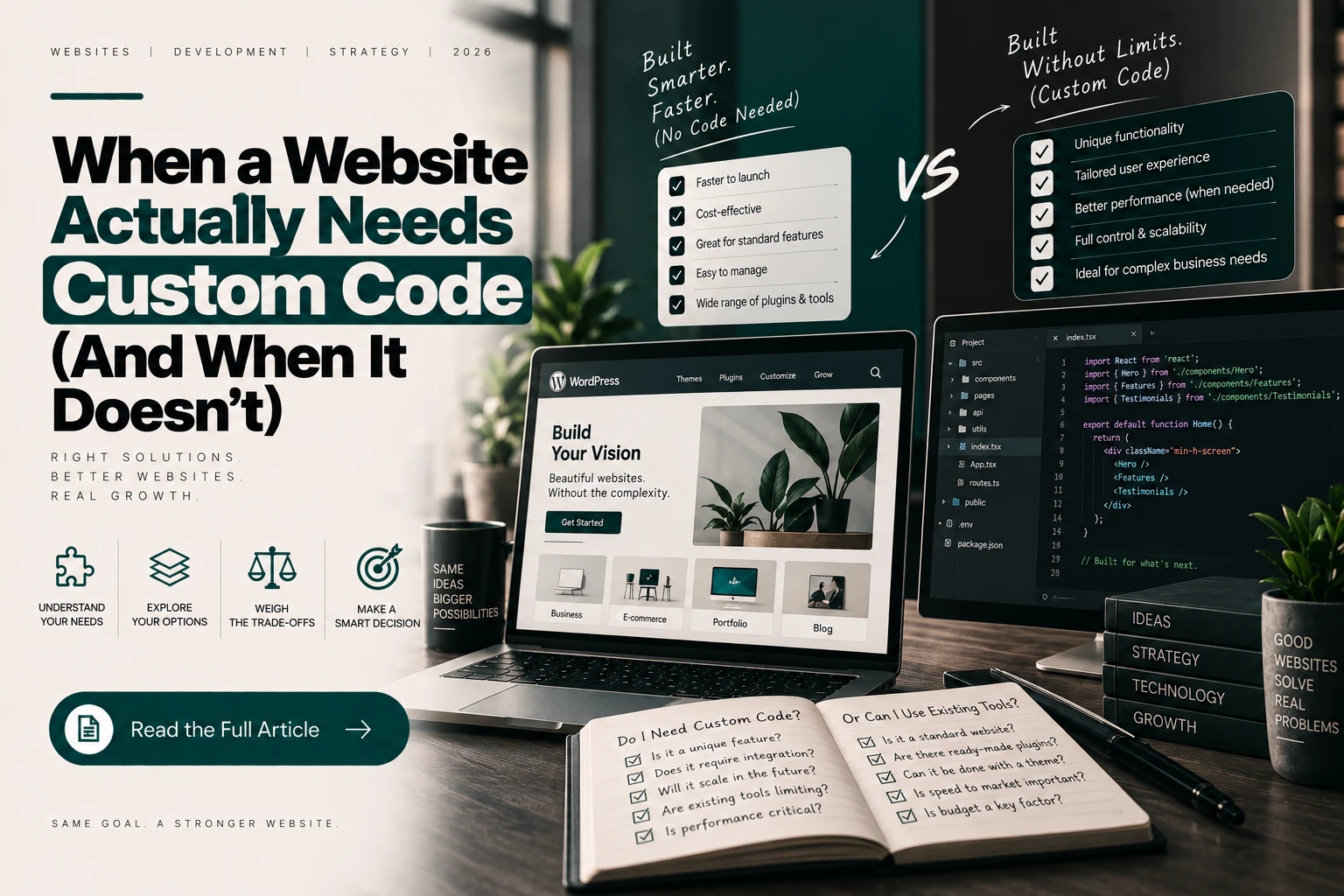
One of the most consequential — and most frequently mishandled — decisions in building a website is whether to use an established platform (WordPress, Shopify, a website builder) or invest in fully custom-coded development. Get it wrong in either direction, and the cost shows up later: either an over-engineered custom build that took far longer and cost far more than a standard platform would have delivered just as well, or a business straining against the limits of a platform that was never built to handle what it’s now being asked to do. Here’s how to actually tell the difference.
The Honest Default: Most Websites Don’t Need Custom Code
This is worth saying plainly, because it runs against what a lot of development conversations imply: the large majority of business websites are genuinely well served by an established platform. Content sites, typical ecommerce stores, service business websites, portfolios — these use cases have been solved thoroughly by mature platforms, and building them from scratch usually means re-solving problems that platforms have already spent years refining, at meaningfully higher cost and longer timelines, without a corresponding benefit.
The Signals That Genuinely Point Toward Custom Development
Your core functionality doesn’t exist as a plugin or app anywhere. If what the business actually needs — a highly specific booking logic, a proprietary calculation tool, an unusual data integration between internal systems — genuinely doesn’t have a reasonable existing solution to adapt, forcing it onto a standard platform usually means fighting the platform’s assumptions rather than benefiting from its maturity.
Performance requirements exceed what a general-purpose platform comfortably handles. Applications with very high transaction volumes, real-time data processing, or unusual performance demands sometimes genuinely need architecture built specifically around those requirements, rather than a general-purpose CMS or ecommerce platform doing extra work to accommodate them.
The product itself is software, not content. If what’s being built is fundamentally a web application — a tool users log into and interact with, rather than a website that primarily presents information or products — this is usually squarely custom development territory, since platforms like WordPress and Shopify are built around content and commerce, not arbitrary application logic.
Long-term differentiation depends on unique functionality. If a specific piece of functionality is meant to be a genuine competitive advantage — something competitors can’t simply replicate by installing the same plugin — building it custom, rather than on top of a widely available platform feature, protects that differentiation more effectively.
The Signals That Point Away From Custom Development
Budget and timeline are genuinely tight. Custom development inherently costs more and takes longer than adapting a mature platform, because it involves building and testing functionality from scratch rather than configuring something already built and proven.
The actual requirements are fairly standard, even if they don’t feel that way internally. It’s common for a business to assume its needs are unique when, in practice, a well-configured platform handles the same underlying requirement most other businesses in the same situation have already solved.
Long-term maintenance capacity is limited. Custom-built software requires ongoing developer involvement for updates, security patching, and fixes in a way that established platforms — with large communities and standardized update processes — generally don’t demand to the same degree.
The Middle Ground Most Businesses Actually Land In
In practice, a lot of the best outcomes come from a hybrid approach: building on an established platform’s foundation, while layering targeted custom development on top for the specific pieces that genuinely need it. This captures the maturity and lower cost of a proven platform for the majority of a website’s functionality, while still allowing genuinely custom-coded website development for the narrower slice of functionality that actually requires it — rather than treating the decision as strictly either/or.
A Practical Way to Decide
- List the actual functional requirements, separate from how the business currently imagines the solution — requirements, not assumed implementations.
- Check honestly whether an established platform already solves each requirement well, rather than assuming uniqueness without verifying.
- Weigh genuine long-term differentiation value against near-term cost and timeline, rather than defaulting to custom development because it feels more impressive or premium.
- Consider a hybrid approach where a proven platform handles the bulk of the site, with custom development reserved specifically for what genuinely requires it.
FAQs
Is custom-coded development always better than using a platform like WordPress or Shopify? No — “better” depends entirely on the specific requirements. For most standard business needs, established platforms deliver equal or better outcomes at lower cost and risk; custom development earns its cost specifically when requirements genuinely exceed what a platform can reasonably support.
How much more expensive is custom development compared to building on a platform? It varies significantly by project scope, but custom development is almost always more expensive and time-consuming upfront than configuring an established platform, since it involves building functionality from scratch rather than adapting proven, existing solutions.
Can a website start on a platform and move to custom development later? Yes, and this is a common, sensible path — starting on a proven platform to validate a business idea, then investing in custom development for specific functionality once genuine, validated needs justify the additional cost and complexity.
The right answer to “custom or platform” is almost never a blanket preference either way — it depends entirely on whether the actual requirements genuinely exceed what a mature, proven platform already solves well.









chat_bubble_outline Leave a Reply