Loading Article Title...
🍪 We use cookies to make sure you get the sweetest experience on our website — smooth, secure, and perfectly tailored just for you! 💫✨
Web Architect & Digital Strategist at Techno Alig. Passionate about building high-performance websites, e-commerce platforms, and data-driven SEO strategies for growing businesses.
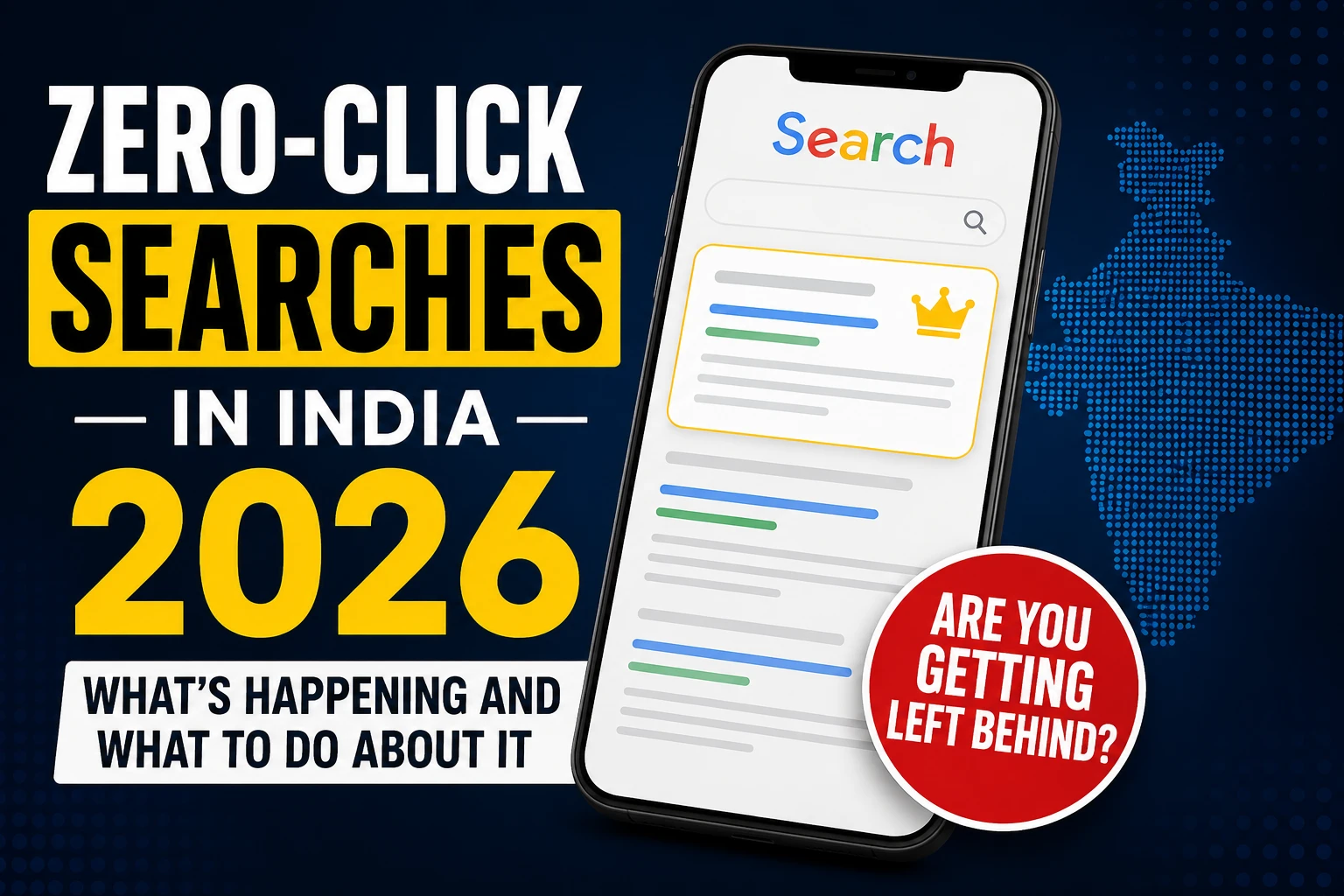
Something significant happened to Google in 2026, and most Indian business owners haven’t heard about it yet.
According to SparkToro’s June 2026 zero-click study, only 276 out of every 1,000 Google searches now result in a click to an external website. The rest — 724 searches out of 1,000 — end without anyone visiting your site, your competitor’s site, or any website at all.
Google answers the question directly. The user gets what they need. They move on.
For anyone who runs a website and depends on Google traffic to generate leads, this is the most important thing happening in digital marketing right now. And the response isn’t panic — it’s adaptation. Here’s what you need to know.
A zero-click search is a Google search that ends without the user clicking any result. Instead of visiting a website, the user gets their answer directly on the Google results page — from a Featured Snippet, a Knowledge Panel, Google Maps, a calculator, a currency converter, or — increasingly — a Google AI Overview.
Zero-click searches aren’t new. They’ve been growing since Google introduced Featured Snippets in 2014. What’s new in 2026 is the scale: searches triggering AI Overviews now show an average zero-click rate of 83%, while traditional queries without AIO average around 60%.
In other words, when a Google AI Overview appears — which happens for 47% of informational queries in India — 8 out of 10 users never click a single link.
Let’s look at what the actual data says, because the headline number hides important nuance.
The global picture: 68.01% of Google searches ended without a click. If you look at AI responses, it is more like only 27.6% of clicks go to the open web.
What that means in practice: Out of 1,000 people searching Google right now:
Desktop searches retain slightly more click-through behavior because users have more screen real estate, multiple tabs open, and different usage patterns. But even desktop zero-click rates climbed from 34% in 2019 to 46.5% in 2026.
The Indian context: India’s search behaviour skews heavily mobile. The mobile zero-click rate is significantly higher than desktop. For Indian businesses targeting mobile users — which is almost every Indian business — the impact is more acute.
Before you overhaul your entire SEO strategy, here’s the crucial nuance: there are still some categories that benefit from SEO, including branded searches, local businesses, and high-intent transactional or tactical queries.
Breaking this down for Indian businesses:
Still getting clicks (prioritise these):
| Search Type | Example | Click Rate |
| Local / near me | “web developer Aligarh” | High — Google Maps shows 3 businesses |
| Transactional | “buy WordPress theme India” | High — purchase intent |
| Branded | “Techno Alig contact” | Very high — user wants you specifically |
| Deep research | “best practices WordPress security 2026” | Medium — user wants full article |
| Comparison | “Shopify vs WooCommerce features comparison” | Medium — needs detail |
Losing clicks fast (AI answers these directly):
| Search Type | Example | Zero-Click Rate |
| Simple definitions | “what is SEO” | 85%+ |
| Quick facts | “WordPress cost India” | 80%+ |
| Calculations | “GST on ₹50,000 services” | 95%+ |
| Conversions | “USD to INR today” | 98%+ |
| Basic how-to | “how to add meta description” | 75%+ |
The pattern is clear: anything Google AI can answer in 2 sentences is now zero-click territory. Anything requiring trust, local knowledge, specific expertise, or a purchase decision still sends clicks.
If your website’s traffic depends primarily on informational blog posts answering basic questions, you’ve almost certainly seen a traffic decline in 2026. This is normal and expected — and it’s Google, not your SEO, that changed.
What hasn’t declined — and won’t in 2026:
Local service searches. When someone in Aligarh searches “website developer near me” or “SEO agency Aligarh”, Google shows a local pack (map + 3 businesses) and organic results. These searches still send clicks because the user wants to find a specific business to hire, not a summary.
High-intent commercial searches. Someone comparing Shopify vs WooCommerce for their new store wants to read multiple perspectives — not a 2-sentence AI summary. These searches still send significant traffic to well-optimised articles.
Brand searches. Anyone searching specifically for “Techno Alig” or your business name will find your website. Building brand recognition — through social media, word of mouth, and PR — is now one of the most valuable SEO activities precisely because it drives branded searches that bypass the zero-click problem.
Local search is the most protected category from zero-click. A business that dominates Google Maps results for “web developer Aligarh” or “digital agency UP” is getting click traffic that AI cannot intercept.
Prioritise your Google Business Profile. Collect reviews consistently. Create location-specific service pages with detailed local content. This is where the highest-return SEO investment now sits for most Indian service businesses.
Zero-click doesn’t mean invisible. When Google AI summarises an answer and attributes it to your website, your brand appears in front of the user even without a click. This is brand impression at scale — and it’s why building genuinely authoritative, citable content matters more than ever.
Write content that has a real chance of being cited in AI Overviews: specific statistics, clear definitions, direct answers to specific questions, and structured FAQ sections. Every article on the Techno Alig blog is structured to maximise this citation probability.
“What is digital marketing” is now zero-click territory. “Digital marketing agency in Aligarh price” is not — it’s a commercial query requiring local business interaction.
Shift your content strategy toward keywords with commercial and transactional intent. These searchers want to buy, hire, or act — and Google doesn’t try to answer them with AI. It shows business listings and review sites instead.
Traffic from Google is now less reliable than it was three years ago. Building a direct relationship with your audience through email creates a channel that doesn’t depend on Google’s algorithm at all.
Every page of your website should offer something valuable in exchange for an email address — a free guide, a checklist, a template, a free audit. This audience stays yours regardless of what Google does next.
YouTube is the one major Google-owned property where zero-click is structurally impossible — to watch a video, you must click on it. YouTube search results appear in Google but require a click to view.
Google’s shift is toward delivering value to the user. Video content delivers value in a format AI cannot fully replicate — personality, visual demonstration, human connection. A Techno Alig YouTube video about “How to speed up a WordPress website” both ranks on YouTube and appears in Google Video results, sending clicks that written articles increasingly cannot.
In this environment, marketers must measure success through visibility, trust, and inclusion within AI-generated content. It’s no longer about where users go — it’s about what they see, who they trust, and which voices shape their understanding before they ever click.
Set up Google Alerts for your business name. Track branded search volume in Google Search Console. Monitor how often your content appears in Google AI Overviews using a tool like Semrush’s AI Visibility Toolkit. These are the metrics that matter in 2026’s zero-click reality.
Zero-click is a real and growing trend. But it’s not the death of SEO — it’s the redirection of it.
The businesses that will struggle are those that built their entire traffic strategy on informational content answering simple questions. The businesses that will thrive are those that:
Our SEO services at Techno Alig are built around this 2026 reality — combining local SEO, commercial-intent content, and AI citation optimisation into a strategy that keeps your business visible regardless of what Google does next.
Get a free SEO audit to see how your site is positioned →
What is zero-click search? A zero-click search is a Google search query that ends without the user clicking any website link. The user gets their answer directly on the Google results page — from an AI Overview, Featured Snippet, Knowledge Panel, or other SERP feature. In 2026, approximately 68% of all Google searches are zero-click.
How many Google searches are zero-click in 2026? According to SparkToro’s June 2026 study, 68.01% of Google searches end without a click to any external website. Only 27.6% of searches result in a click to the open web when AI responses are factored in. Searches with Google AI Overviews have an 83% zero-click rate.
Does zero-click search affect local businesses in India? Less than informational websites. Local searches like “web developer Aligarh” or “restaurant near me” still generate strong click-through rates because Google shows a local map pack requiring a click to access business details. Local SEO remains one of the most click-protected categories in 2026.
What types of searches still send clicks to websites in 2026? Local searches, branded searches, transactional searches, and complex research queries still send strong click-through traffic. Simple informational queries answerable in 2 sentences — definitions, quick facts, calculations, basic how-to questions — are now predominantly zero-click.How should Indian businesses adapt their SEO for zero-click searches? Focus on: local SEO (most protected), commercial-intent keywords, brand-building through social and email, video content on YouTube, and structuring articles to be cited in AI Overviews. Shift measurement toward brand visibility and direct enquiries rather than raw organic traffic volume.

If you’re looking for a reliable Web Developer in Aligarh, look no further than Techno Alig. Contact us today to discuss your project and take the first step towards establishing a powerful online presence.

No spam, notifications only about new offers, services.
chat_bubble_outline Leave a Reply